

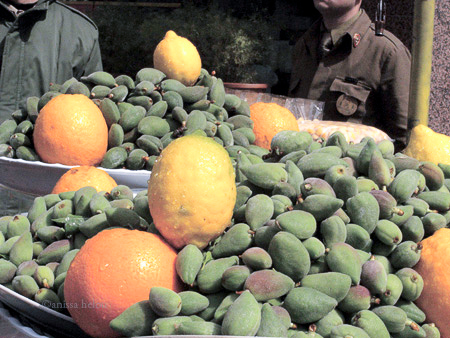
It’s green almonds season again. In full flow now but they were really expensive at the beginning — I paid $7 for 200 g about a month ago in Beirut which is a large amount of money for so little. Fortunately, when I went to Damascus a couple of weeks later, they were more plentiful and cheaper of course, and a lot larger too.
They sell two types there, very large and medium large and normally sprinkled water to make them look more appetizing except that the hygiene of the water is often questionable. As I walked around the modern part of the city, I chanced upon a street vendor who not only sold green almonds but also lupin seeds which I hadn’t seen on the street for a while. But the poor guy was quickly stopped by two military police who asked to see his license, both to check whether he had the right to be where he was and whether he was allowed to sell both almonds and lupin seeds — they are very strict there unlike Lebanon where anything goes, well almost.

Turned out he didn’t have a license to sell almonds and he couldn’t convince them to let him get away with it. As I watched the scene, I thought of buying his stock but I couldn’t have eaten so many however much I love munching on them dipped in salt. And the whole discussion between him and them was taking too long, so, I left without finding out what the outcome was. I guess he must have offloaded the almonds onto one of the nearby greengrocers.

As for the lupin seeds (known as tormus in Arabic), they are an ancient pulse that has been part of the Mediterranean diet from as far back as the third century BC. The seeds need to be soaked for a few days before they become edible. Start by soaking the dried pulses in plenty of fresh water (8 cups water for 1 1/2 cups lupin seeds) for 24 hours then blanch them for 5 minutes. Drain, rinse and put to soak again in cold water for a week. During that time, change the water 3-4 times every day. Then drain the seeds and chill before serving salted as a snack or part of a mezze. The soaked seeds, as you can see from the picture above, are bright yellow, round and flat with a thick opaque skin which you need to remove before eating. In Israel they sell them on the street in newspaper cones topped with a mixture of salt, ground cumin and chopped parsley. Sometimes you will be given a lemon wedge to squeeze over the seeds. I guess my Damascus vendor must have sold them in paper cups, as I didn’t see any newspaper cones on his cart.
They make a very nourishing and healthy snack and you can buy them dried or pre-soaked in Middle Eastern stores. I have also seen them at the Pasta Shop in Rockridge, California and who knows, they may even have them at Wholefoods.

