savoury mastic

17, June

Anissa: It has been quite some time since the great Charles Perry wrote a guest post and I was delighted when he suggested mastic, one of my favourite ingredients, except that he is writing about it in the context of savoury cooking which is fascinating.

Charles: With its heady resinous aroma, mastic seems a natural flavoring for sweets. The Greeks  and Turks drink mastic syrup with coffee; they put it in ice cream and Turkish  delight. The Moroccans can’t seem to grind almonds without throwing in a  little mastic.

And yet medieval Arab cooks scarcely ever flavor sweets  with mastic – it was more likely to contribute its aroma to meat dishes. The  greatest mastic fan on record is Muhammad b. al-Hasan al-Baghdadi, because  mastic appears in more than half of the 96 red meat recipes in his 1226 book  Kitab al-Tabikh.

Al-Baghdadi went so far as to insist that when you  cook chicken, you must always boil it and then fry it with cinnamon, coriander and mastic before adding any other flavoring. To be sure, not everybody agreed  with him on this, or with his dogmatic assertion that chicken should never be flavored with garlic. Certainly not the Moors of medieval Spain and North  Africa, where a dish called thumiyya was essentially poulet aux 40 gousses d’ail (plus the obligatory medieval spices and ground almonds). In  fact, the Moorish cookbooks scarcely call for mastic at all.

Even in  al-Baghdadi’s book, though, mastic was just one spice among others, usually  appearing alongside the three C’s of medieval Arab cuisine: cumin, coriander  and cinnamon. Its closest approach to a starring role was a dish called masus, which was kid cooked with vinegar, fried celery leaves, mastic and saffron. But when masus sauce was used on lamb or hardboiled eggs,  the three C’s and pepper would show up.
More typical was the recipe  for roast fish (samak mashwi). It starts with mixing up a typical medieval fish stuffing (6 parts sumac, 5 parts ground walnuts, 3 parts thyme and 1 part crushed garlic – try it some time, it’s great). You sprinkle this with coriander, cinnamon, cumin and mastic before stuffing the fish and roasting it in a tandoor.

So far as I know, the only place in the modern world where mastic is still associated with savory dishes, rather than sweets, is Egypt. Egyptian chicken, duck, rabbit and fish recipes often call for  mastic. With red meat, it seems confined to tripe, lamb shanks, gizzards and  brains.

Where mastic appears, it’s cardamom, rather than the three C’s, that tends to come along for the ride. Half the recipes calling for mastic in Samia Abdennour’s Egyptian Cooking (1984) also include cardamom, and in Usul al-Tahy al-Nazari wal-‘Amali, by Nazira Niqula and Nahiyya ‘Uthman (1965), only two recipes contain mastic but no cardamom.

How do they use it? When you make boiled rabbit or Circassian chicken, Egyptian style, you’re  likely to start out by boiling the meat with onion, mastic and cardamom. A typical fish dish would be samak misabbik abyad: thick tranches fried with cardamom and mastic, then cooked in a flour-thickened sauce and finished off with lemon juice. Shorba akari’ is lamb shanks boiled with mastic, cardamom and lemon juice.

But I don’t find mastic in even one sweet dish in these two books. No idea why. It must just be Egyptian exceptionalism.

Here are a couple of al-Baghdadi’s recipes to choose from. Mamquriyya is about the simplest stew in the book that includes mastic (not counting masus). In Chapter 1, there is a section “On yogurt and what is cooked from it,” seven recipes, all containing mastic (1/7 of the mastic recipes in the book), so there was a sort of yogurt/mastic syndrome, and I’m also including Masliyya for good measure.

Mamquriyya. The way to make it is to cut up fat meat small and throw it in the pot, along with a little salt. Throw on water to cover, then bring it to the boil and remove its scum. When it is nearly done, throw on the spices coriander, cumin, cinnamon, mastic and pepper, and chopped onions. When it is done, throw on one part wine vinegar and two parts murri (soy sauce). Throw a small handful of whole coriander seeds on the pot, sprinkle it with rose water and leave it to grow quiet on the fire, and take it up.

Masliyya. The way to make it is to cut up fat meat and boil it as usual, and remove the scum. When it is done, throw on a handful of chopped onion, a little salt, ground dry coriander, cumin, pepper, sticks of cinnamon and mastic. When its liquid has dried up and the fat appears, take dried whey, pound it fine, throw hot water on it and macerate it well by hand until it becomes like sour yogurt (in appearance) and of the same consistency, then throw it in the pot. Grind a little garlic and throw it in the pot with bunches of fresh mint. Sprinkle some finely ground cinnamon on the surface. Then wipe the sides of the pot with a clean cloth, leave it on the fire awhile to grow quiet and take it up.

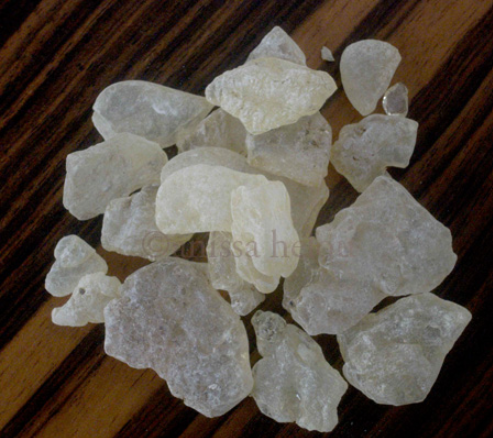
Al-Baghdadi has advice on the kind of mastic “that which has large, white, lustrous grains, not pounded, free of dust and dirt.”

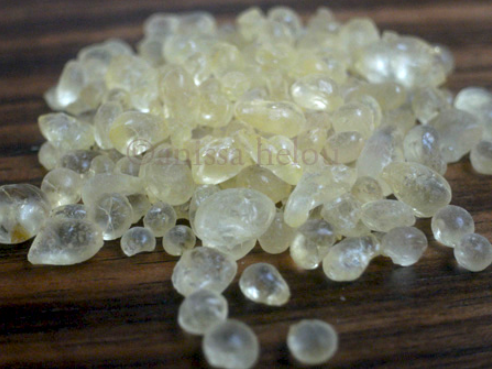
Anissa: Al-Baghdadi’s piece of advice on what kind of mastic is interesting because in Lebanon, we prefer the smaller, more transparent drops you see in the top picture whereas he favours the larger grains in the middle picture. In Chios, the island where all of the mastic comes from, they collect and grade mastic in two different types. Here is what I wrote about it in my Savory Baking from the Mediterranean book:

“…mastic, the dried resin that seeps through the bark of the Pistacia lentiscus, an evergreen tree native to the Mediterranean basin. Mastic is harvested in July and August. Gum mastic producers go to the fields very early in the morning and make incisions in the trees for the resin to seep out, a process called kentima. The transparent resin is then collected and rinsed in barrels. After that, it is spread out and left to dry then sorted by hand. There are two kinds of mastic. The clear, tiny crystals which are called ‘dahtilidopetres’, (flintstones) and the larger, spotted soft ones which are called ‘kantiles’ (blisters). The latter is a lesser grade and is normally used for chewing — the resin being a natural chewing gum — while the finer grade is used in cooking.”

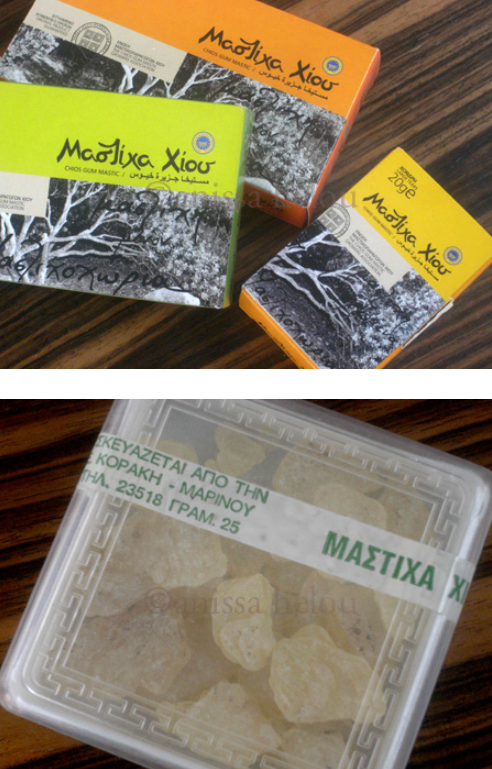
You can buy mastic in Middle Eastern shops where it is normally sold in small sachets — it is an expensive ingredient. However, there is a wonderful Greek mastiha shop which I went to in Athens when they had only one shop. They now have branches in New York and I think also in London and Paris. Their packaging is gorgeous and you can buy industrial quantities there as well as all kinds of things flavoured with mastic including ouzo and soap! And don’t worry about buying too much. Mastic lasts forever. I’ve had mine for years and the flavor is still the same.
Share:

Comments

Leave the first comment

<!-- if comments are disabled for this post then hide comments container -->
<style> 
<?php if(!comments_open()) { echo "#nfps-comments-container {display: none !important;}"; }?>
</style>

savoury mastic

17, June

Anissa: It has been quite some time since the great Charles Perry wrote a guest post and I was delighted when he suggested mastic, one of my favourite ingredients, except that he is writing about it in the context of savoury cooking which is fascinating.

Charles: With its heady resinous aroma, mastic seems a natural flavoring for sweets. The Greeks  and Turks drink mastic syrup with coffee; they put it in ice cream and Turkish  delight. The Moroccans can’t seem to grind almonds without throwing in a  little mastic.

And yet medieval Arab cooks scarcely ever flavor sweets  with mastic – it was more likely to contribute its aroma to meat dishes. The  greatest mastic fan on record is Muhammad b. al-Hasan al-Baghdadi, because  mastic appears in more than half of the 96 red meat recipes in his 1226 book  Kitab al-Tabikh.

Al-Baghdadi went so far as to insist that when you  cook chicken, you must always boil it and then fry it with cinnamon, coriander and mastic before adding any other flavoring. To be sure, not everybody agreed  with him on this, or with his dogmatic assertion that chicken should never be flavored with garlic. Certainly not the Moors of medieval Spain and North  Africa, where a dish called thumiyya was essentially poulet aux 40 gousses d’ail (plus the obligatory medieval spices and ground almonds). In  fact, the Moorish cookbooks scarcely call for mastic at all.

Even in  al-Baghdadi’s book, though, mastic was just one spice among others, usually  appearing alongside the three C’s of medieval Arab cuisine: cumin, coriander  and cinnamon. Its closest approach to a starring role was a dish called masus, which was kid cooked with vinegar, fried celery leaves, mastic and saffron. But when masus sauce was used on lamb or hardboiled eggs,  the three C’s and pepper would show up.

More typical was the recipe  for roast fish (samak mashwi). It starts with mixing up a typical medieval fish stuffing (6 parts sumac, 5 parts ground walnuts, 3 parts thyme and 1 part crushed garlic – try it some time, it’s great). You sprinkle this with coriander, cinnamon, cumin and mastic before stuffing the fish and roasting it in a tandoor.

So far as I know, the only place in the modern world where mastic is still associated with savory dishes, rather than sweets, is Egypt. Egyptian chicken, duck, rabbit and fish recipes often call for  mastic. With red meat, it seems confined to tripe, lamb shanks, gizzards and  brains.

Where mastic appears, it’s cardamom, rather than the three C’s, that tends to come along for the ride. Half the recipes calling for mastic in Samia Abdennour’s Egyptian Cooking (1984) also include cardamom, and in Usul al-Tahy al-Nazari wal-‘Amali, by Nazira Niqula and Nahiyya ‘Uthman (1965), only two recipes contain mastic but no cardamom.

How do they use it? When you make boiled rabbit or Circassian chicken, Egyptian style, you’re  likely to start out by boiling the meat with onion, mastic and cardamom. A typical fish dish would be samak misabbik abyad: thick tranches fried with cardamom and mastic, then cooked in a flour-thickened sauce and finished off with lemon juice. Shorba akari’ is lamb shanks boiled with mastic, cardamom and lemon juice.

But I don’t find mastic in even one sweet dish in these two books. No idea why. It must just be Egyptian exceptionalism.

Here are a couple of al-Baghdadi’s recipes to choose from. Mamquriyya is about the simplest stew in the book that includes mastic (not counting masus). In Chapter 1, there is a section “On yogurt and what is cooked from it,” seven recipes, all containing mastic (1/7 of the mastic recipes in the book), so there was a sort of yogurt/mastic syndrome, and I’m also including Masliyya for good measure.

Mamquriyya. The way to make it is to cut up fat meat small and throw it in the pot, along with a little salt. Throw on water to cover, then bring it to the boil and remove its scum. When it is nearly done, throw on the spices coriander, cumin, cinnamon, mastic and pepper, and chopped onions. When it is done, throw on one part wine vinegar and two parts murri (soy sauce). Throw a small handful of whole coriander seeds on the pot, sprinkle it with rose water and leave it to grow quiet on the fire, and take it up.

Masliyya. The way to make it is to cut up fat meat and boil it as usual, and remove the scum. When it is done, throw on a handful of chopped onion, a little salt, ground dry coriander, cumin, pepper, sticks of cinnamon and mastic. When its liquid has dried up and the fat appears, take dried whey, pound it fine, throw hot water on it and macerate it well by hand until it becomes like sour yogurt (in appearance) and of the same consistency, then throw it in the pot. Grind a little garlic and throw it in the pot with bunches of fresh mint. Sprinkle some finely ground cinnamon on the surface. Then wipe the sides of the pot with a clean cloth, leave it on the fire awhile to grow quiet and take it up.

Al-Baghdadi has advice on the kind of mastic “that which has large, white, lustrous grains, not pounded, free of dust and dirt.”

Anissa: Al-Baghdadi’s piece of advice on what kind of mastic is interesting because in Lebanon, we prefer the smaller, more transparent drops you see in the top picture whereas he favours the larger grains in the middle picture. In Chios, the island where all of the mastic comes from, they collect and grade mastic in two different types. Here is what I wrote about it in my Savory Baking from the Mediterranean book:

“…mastic, the dried resin that seeps through the bark of the Pistacia lentiscus, an evergreen tree native to the Mediterranean basin. Mastic is harvested in July and August. Gum mastic producers go to the fields very early in the morning and make incisions in the trees for the resin to seep out, a process called kentima. The transparent resin is then collected and rinsed in barrels. After that, it is spread out and left to dry then sorted by hand. There are two kinds of mastic. The clear, tiny crystals which are called ‘dahtilidopetres’, (flintstones) and the larger, spotted soft ones which are called ‘kantiles’ (blisters). The latter is a lesser grade and is normally used for chewing — the resin being a natural chewing gum — while the finer grade is used in cooking.”

You can buy mastic in Middle Eastern shops where it is normally sold in small sachets — it is an expensive ingredient. However, there is a wonderful Greek mastiha shop which I went to in Athens when they had only one shop. They now have branches in New York and I think also in London and Paris. Their packaging is gorgeous and you can buy industrial quantities there as well as all kinds of things flavoured with mastic including ouzo and soap! And don’t worry about buying too much. Mastic lasts forever. I’ve had mine for years and the flavor is still the same.

Share:

Comments

Leave the first comment

<!-- if comments are disabled for this post then hide comments container -->
<style> 
<?php if(!comments_open()) { echo "#nfps-comments-container {display: none !important;}"; }?>
</style>

savoury mastic

17, June

Anissa: It has been quite some time since the great Charles Perry wrote a guest post and I was delighted when he suggested mastic, one of my favourite ingredients, except that he is writing about it in the context of savoury cooking which is fascinating.

Charles: With its heady resinous aroma, mastic seems a natural flavoring for sweets. The Greeks  and Turks drink mastic syrup with coffee; they put it in ice cream and Turkish  delight. The Moroccans can’t seem to grind almonds without throwing in a  little mastic.

And yet medieval Arab cooks scarcely ever flavor sweets  with mastic – it was more likely to contribute its aroma to meat dishes. The  greatest mastic fan on record is Muhammad b. al-Hasan al-Baghdadi, because  mastic appears in more than half of the 96 red meat recipes in his 1226 book  Kitab al-Tabikh.

Al-Baghdadi went so far as to insist that when you  cook chicken, you must always boil it and then fry it with cinnamon, coriander and mastic before adding any other flavoring. To be sure, not everybody agreed  with him on this, or with his dogmatic assertion that chicken should never be flavored with garlic. Certainly not the Moors of medieval Spain and North  Africa, where a dish called thumiyya was essentially poulet aux 40 gousses d’ail (plus the obligatory medieval spices and ground almonds). In  fact, the Moorish cookbooks scarcely call for mastic at all.

Even in  al-Baghdadi’s book, though, mastic was just one spice among others, usually  appearing alongside the three C’s of medieval Arab cuisine: cumin, coriander  and cinnamon. Its closest approach to a starring role was a dish called masus, which was kid cooked with vinegar, fried celery leaves, mastic and saffron. But when masus sauce was used on lamb or hardboiled eggs,  the three C’s and pepper would show up.

More typical was the recipe  for roast fish (samak mashwi). It starts with mixing up a typical medieval fish stuffing (6 parts sumac, 5 parts ground walnuts, 3 parts thyme and 1 part crushed garlic – try it some time, it’s great). You sprinkle this with coriander, cinnamon, cumin and mastic before stuffing the fish and roasting it in a tandoor.

So far as I know, the only place in the modern world where mastic is still associated with savory dishes, rather than sweets, is Egypt. Egyptian chicken, duck, rabbit and fish recipes often call for  mastic. With red meat, it seems confined to tripe, lamb shanks, gizzards and  brains.

Where mastic appears, it’s cardamom, rather than the three C’s, that tends to come along for the ride. Half the recipes calling for mastic in Samia Abdennour’s Egyptian Cooking (1984) also include cardamom, and in Usul al-Tahy al-Nazari wal-‘Amali, by Nazira Niqula and Nahiyya ‘Uthman (1965), only two recipes contain mastic but no cardamom.

How do they use it? When you make boiled rabbit or Circassian chicken, Egyptian style, you’re  likely to start out by boiling the meat with onion, mastic and cardamom. A typical fish dish would be samak misabbik abyad: thick tranches fried with cardamom and mastic, then cooked in a flour-thickened sauce and finished off with lemon juice. Shorba akari’ is lamb shanks boiled with mastic, cardamom and lemon juice.

But I don’t find mastic in even one sweet dish in these two books. No idea why. It must just be Egyptian exceptionalism.

Here are a couple of al-Baghdadi’s recipes to choose from. Mamquriyya is about the simplest stew in the book that includes mastic (not counting masus). In Chapter 1, there is a section “On yogurt and what is cooked from it,” seven recipes, all containing mastic (1/7 of the mastic recipes in the book), so there was a sort of yogurt/mastic syndrome, and I’m also including Masliyya for good measure.

Mamquriyya. The way to make it is to cut up fat meat small and throw it in the pot, along with a little salt. Throw on water to cover, then bring it to the boil and remove its scum. When it is nearly done, throw on the spices coriander, cumin, cinnamon, mastic and pepper, and chopped onions. When it is done, throw on one part wine vinegar and two parts murri (soy sauce). Throw a small handful of whole coriander seeds on the pot, sprinkle it with rose water and leave it to grow quiet on the fire, and take it up.

Masliyya. The way to make it is to cut up fat meat and boil it as usual, and remove the scum. When it is done, throw on a handful of chopped onion, a little salt, ground dry coriander, cumin, pepper, sticks of cinnamon and mastic. When its liquid has dried up and the fat appears, take dried whey, pound it fine, throw hot water on it and macerate it well by hand until it becomes like sour yogurt (in appearance) and of the same consistency, then throw it in the pot. Grind a little garlic and throw it in the pot with bunches of fresh mint. Sprinkle some finely ground cinnamon on the surface. Then wipe the sides of the pot with a clean cloth, leave it on the fire awhile to grow quiet and take it up.

Al-Baghdadi has advice on the kind of mastic “that which has large, white, lustrous grains, not pounded, free of dust and dirt.”

Anissa: Al-Baghdadi’s piece of advice on what kind of mastic is interesting because in Lebanon, we prefer the smaller, more transparent drops you see in the top picture whereas he favours the larger grains in the middle picture. In Chios, the island where all of the mastic comes from, they collect and grade mastic in two different types. Here is what I wrote about it in my Savory Baking from the Mediterranean book:

“…mastic, the dried resin that seeps through the bark of the Pistacia lentiscus, an evergreen tree native to the Mediterranean basin. Mastic is harvested in July and August. Gum mastic producers go to the fields very early in the morning and make incisions in the trees for the resin to seep out, a process called kentima. The transparent resin is then collected and rinsed in barrels. After that, it is spread out and left to dry then sorted by hand. There are two kinds of mastic. The clear, tiny crystals which are called ‘dahtilidopetres’, (flintstones) and the larger, spotted soft ones which are called ‘kantiles’ (blisters). The latter is a lesser grade and is normally used for chewing — the resin being a natural chewing gum — while the finer grade is used in cooking.”

You can buy mastic in Middle Eastern shops where it is normally sold in small sachets — it is an expensive ingredient. However, there is a wonderful Greek mastiha shop which I went to in Athens when they had only one shop. They now have branches in New York and I think also in London and Paris. Their packaging is gorgeous and you can buy industrial quantities there as well as all kinds of things flavoured with mastic including ouzo and soap! And don’t worry about buying too much. Mastic lasts forever. I’ve had mine for years and the flavor is still the same.

Share:

Comments

Leave the first comment

<!-- if comments are disabled for this post then hide comments container -->
<style> 
<?php if(!comments_open()) { echo "#nfps-comments-container {display: none !important;}"; }?>
</style>