salep or sahlab in arabic, a rare ingredient

23, June

I have known salep all my life. I have had it in ice cream and in the eponymous winter drink which we used to buy on the street in Beirut after late nights out on the town, to have with croissants or ka’keh (sesame galette). Still, it wasn’t until a couple of years ago that I finally saw what salep looks like in its un-powdered form. I was walking through the bazaars of Safranbolu, in Turkey’s Black Sea region with my great friend, Nevin Halici, when I noticed lovely necklaces of dried translucent objects hanging outside several shops. I asked Nevin what they were and she said salep (dried orchis tubers that are ground into a fine powder which acts as a thickening agent). And inside the shop we entered, there was a very large jar of the salep in powdered form.

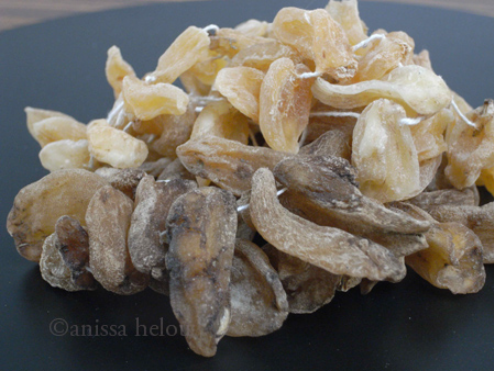
Very exciting. I had never seen so much salep in my whole life. I had to buy some of course. But before I committed to spending a respectable sum — salep is rare and precious and as a result expensive — I asked Nevin to be my taster to make sure it was good quality. It is often mixed with cornstarch. Nevin approved and I left the shop with several necklaces plus an enormous amount of ground salep. Enough to last me years. You can see from the picture that the tubers are different. Some are dark and large and others are smaller, lighter and somewhat transparent. This is because they are different tubers.

They are too hard to grind at home but I like to have them lying around. They are very pretty; and I use them in some of my classes to show students what salep looks like. As for the powdered stock, I am going through it slowly and now that the weather is cooling, I will be making the drink again. Here is a recipe just in case you can get some.

Salep/Sahlab

The best salep is Turkish and you can recognise it from the slightly greyish colour of the fine powder. Salep in Turkey is usually drunk with simit, and in Israel and Egypt, it is garnished with nuts, raisins, and dessicated coconut while in Lebanon and Syria the garnish is a sprinkling of ground cinnamon. A similar drink was common in France in the 17th-century. Here is more on the subject.

Serves 4

4 cups whole milk

1/2 teaspoon ground mastic

1 tablespoon Turkish salep

6 tablespoons sugar

ground cinnamon for garnish

Pour the milk in a saucepan and place over a medium heat. As the milk warms up, remove a little and mix it with the mastic. Bring the rest of the milk to the boil then add the salep little by little, in very small amounts so that it does not form lumps. Keep stirring over the heat for about 5 minutes, before adding the sugar and stirring for another 3 minutes. Stir in the mastic milk and ladle into soup bowls. Sprinkle with the cinnamon and serve hot as is or with simit, ka’keh or croissants.

©anissa helou from Mediterranean Street Food

And here is a short clip which I shot in the most wonderful cafe in Safranbolu where the owner played music with some friends, while a lady made saç boreks and we drank tea. Must go back.

Share:

Comments

Leave the first comment

<!-- if comments are disabled for this post then hide comments container -->
<style> 
<?php if(!comments_open()) { echo "#nfps-comments-container {display: none !important;}"; }?>
</style>

salep or sahlab in arabic, a rare ingredient

23, June

I have known salep all my life. I have had it in ice cream and in the eponymous winter drink which we used to buy on the street in Beirut after late nights out on the town, to have with croissants or ka’keh (sesame galette). Still, it wasn’t until a couple of years ago that I finally saw what salep looks like in its un-powdered form. I was walking through the bazaars of Safranbolu, in Turkey’s Black Sea region with my great friend, Nevin Halici, when I noticed lovely necklaces of dried translucent objects hanging outside several shops. I asked Nevin what they were and she said salep (dried orchis tubers that are ground into a fine powder which acts as a thickening agent). And inside the shop we entered, there was a very large jar of the salep in powdered form.

Very exciting. I had never seen so much salep in my whole life. I had to buy some of course. But before I committed to spending a respectable sum — salep is rare and precious and as a result expensive — I asked Nevin to be my taster to make sure it was good quality. It is often mixed with cornstarch. Nevin approved and I left the shop with several necklaces plus an enormous amount of ground salep. Enough to last me years. You can see from the picture that the tubers are different. Some are dark and large and others are smaller, lighter and somewhat transparent. This is because they are different tubers.

They are too hard to grind at home but I like to have them lying around. They are very pretty; and I use them in some of my classes to show students what salep looks like. As for the powdered stock, I am going through it slowly and now that the weather is cooling, I will be making the drink again. Here is a recipe just in case you can get some.

Salep/Sahlab

The best salep is Turkish and you can recognise it from the slightly greyish colour of the fine powder. Salep in Turkey is usually drunk with simit, and in Israel and Egypt, it is garnished with nuts, raisins, and dessicated coconut while in Lebanon and Syria the garnish is a sprinkling of ground cinnamon. A similar drink was common in France in the 17th-century. Here is more on the subject.

Serves 4

4 cups whole milk

1/2 teaspoon ground mastic

1 tablespoon Turkish salep

6 tablespoons sugar

ground cinnamon for garnish

Pour the milk in a saucepan and place over a medium heat. As the milk warms up, remove a little and mix it with the mastic. Bring the rest of the milk to the boil then add the salep little by little, in very small amounts so that it does not form lumps. Keep stirring over the heat for about 5 minutes, before adding the sugar and stirring for another 3 minutes. Stir in the mastic milk and ladle into soup bowls. Sprinkle with the cinnamon and serve hot as is or with simit, ka’keh or croissants.

©anissa helou from Mediterranean Street Food

And here is a short clip which I shot in the most wonderful cafe in Safranbolu where the owner played music with some friends, while a lady made saç boreks and we drank tea. Must go back.

Share:

Comments

Leave the first comment

<!-- if comments are disabled for this post then hide comments container -->
<style> 
<?php if(!comments_open()) { echo "#nfps-comments-container {display: none !important;}"; }?>
</style>

salep or sahlab in arabic, a rare ingredient

23, June

I have known salep all my life. I have had it in ice cream and in the eponymous winter drink which we used to buy on the street in Beirut after late nights out on the town, to have with croissants or ka’keh (sesame galette). Still, it wasn’t until a couple of years ago that I finally saw what salep looks like in its un-powdered form. I was walking through the bazaars of Safranbolu, in Turkey’s Black Sea region with my great friend, Nevin Halici, when I noticed lovely necklaces of dried translucent objects hanging outside several shops. I asked Nevin what they were and she said salep (dried orchis tubers that are ground into a fine powder which acts as a thickening agent). And inside the shop we entered, there was a very large jar of the salep in powdered form.

Very exciting. I had never seen so much salep in my whole life. I had to buy some of course. But before I committed to spending a respectable sum — salep is rare and precious and as a result expensive — I asked Nevin to be my taster to make sure it was good quality. It is often mixed with cornstarch. Nevin approved and I left the shop with several necklaces plus an enormous amount of ground salep. Enough to last me years. You can see from the picture that the tubers are different. Some are dark and large and others are smaller, lighter and somewhat transparent. This is because they are different tubers.

They are too hard to grind at home but I like to have them lying around. They are very pretty; and I use them in some of my classes to show students what salep looks like. As for the powdered stock, I am going through it slowly and now that the weather is cooling, I will be making the drink again. Here is a recipe just in case you can get some.

Salep/Sahlab

The best salep is Turkish and you can recognise it from the slightly greyish colour of the fine powder. Salep in Turkey is usually drunk with simit, and in Israel and Egypt, it is garnished with nuts, raisins, and dessicated coconut while in Lebanon and Syria the garnish is a sprinkling of ground cinnamon. A similar drink was common in France in the 17th-century. Here is more on the subject.

Serves 4

4 cups whole milk

1/2 teaspoon ground mastic

1 tablespoon Turkish salep

6 tablespoons sugar

ground cinnamon for garnish

Pour the milk in a saucepan and place over a medium heat. As the milk warms up, remove a little and mix it with the mastic. Bring the rest of the milk to the boil then add the salep little by little, in very small amounts so that it does not form lumps. Keep stirring over the heat for about 5 minutes, before adding the sugar and stirring for another 3 minutes. Stir in the mastic milk and ladle into soup bowls. Sprinkle with the cinnamon and serve hot as is or with simit, ka’keh or croissants.

©anissa helou from Mediterranean Street Food

And here is a short clip which I shot in the most wonderful cafe in Safranbolu where the owner played music with some friends, while a lady made saç boreks and we drank tea. Must go back.

Share:

Comments

Leave the first comment

<!-- if comments are disabled for this post then hide comments container -->
<style> 
<?php if(!comments_open()) { echo "#nfps-comments-container {display: none !important;}"; }?>
</style>