pomegranates: a myth and how to take the seeds out

15, June

Like figs, pomegranates are the symbol of fertility. Legend has it that Persephone, the daughter of Demeter, the goddess of fruit and fertility, was carried off to the underworld by Pluto. To force Persephones’s release, Demeter prevented plants from bearing fruit thus creating winter which did not exist previously. Persephone also did her bit by going on a hunger strike although she eventually succumbed and ate a pomegranate which she spat out except for 6 seeds. After which Demeter struck a deal with Pluto whereby she agreed that he would keep her daughter for 6 months of the year, one month for each seed, and she would have her for the remaining 6 months. And this is how summer and winter were created with pomegranates starting to ripen towards the end of summer.

They have just started appearing in the Lebanese shops here and very soon, they will be ripening on Mary Taylor Simeti’s trees in Sicily.  We were exchanging emails the other day when she asked what would be the best way to take the seeds out. I said I would post it as I would be eating a lot of pomegranates from now until the end of the season. So, here is what I do which is also what most people in the Middle East do. It is a slow process but it produces totally unblemished seeds without any bits of the bitter pith which spoils the sweet taste of the pomegranate seeds.

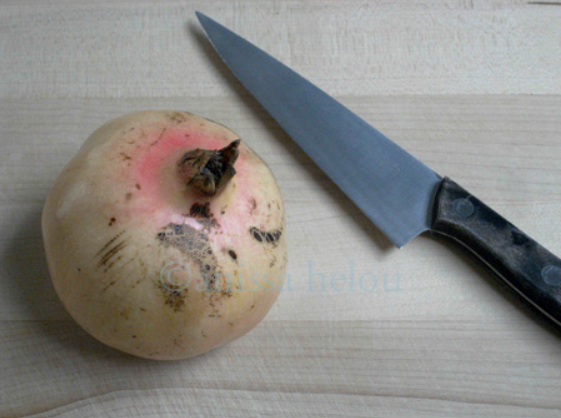
Using a sharp knife, cut and discard the top skin off the pomegranate, also the bottom. Then taking the pith line as a marker, cut into the skin to create wedges as if you were cutting to peel an orange. If the middle bit of the pith is very thick, insert the tip of your knife in between it and the seeds and flick it out. Then gently break the pomegranate in half.
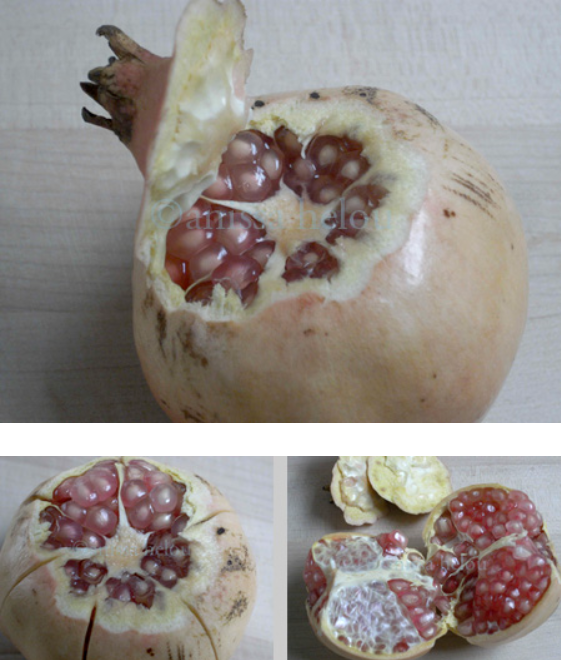
Break the halves into wedges and peel each, both the thick outer skin and the thin one covering the seeds before carefully prising the seeds off the pith by pushing them against the direction they are attached to the pith. If you do this slowly and gently, you will not get any juice on your fingers.
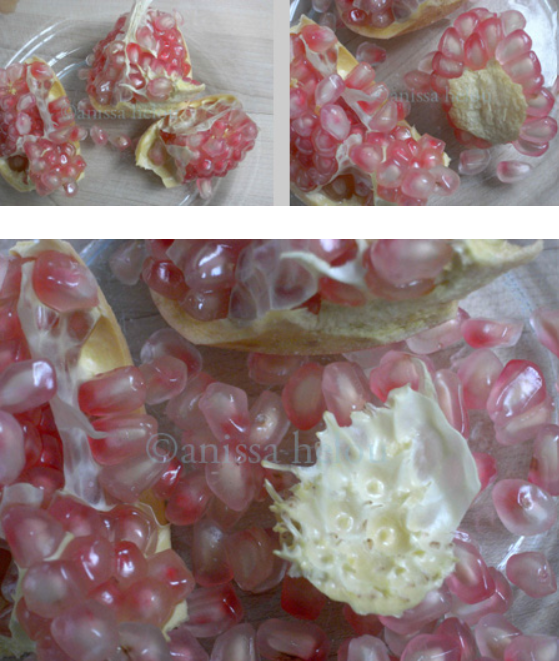
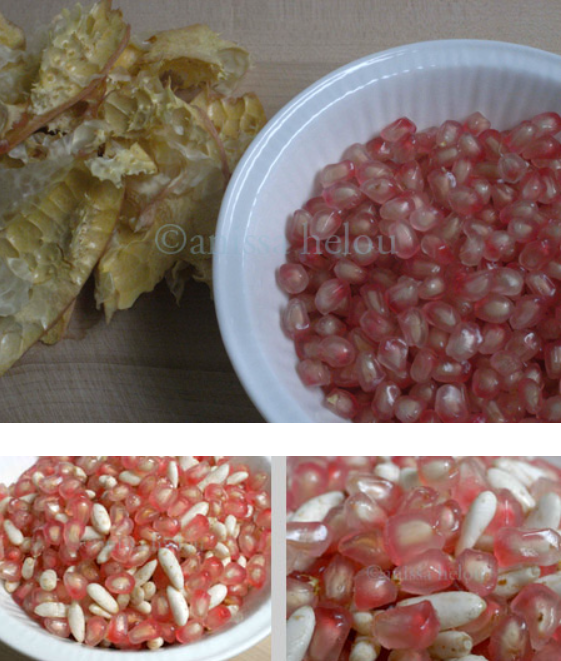
This will take some time but you will end up with a beautiful, crisp bowl of jewel-like pomegranate seeds. The one I peeled here has very pale lustrous seeds that are sweet and juicy although not yet at their very best. I expect it will be in another couple of weeks before I can buy perfect ones. Still, it was delicious. I love mixing the seeds with soaked pine nuts — soaking nuts (preferably overnight to allow them enough time to rehydrate) makes them taste as if they are fresh. I will have to try the next batch with wet walnuts which are also in season!
I have tried taking the shorter route of cutting the pomegranate in half and tapping on the skin with a knife to let the seeds drop but I don’t like doing it this way. The seeds are fragile and some of them will bruise. It is also messier with juice spurting out. My slow method is neat, and it also has a serene, meditative quality to it which I like. Anyhow, whichever way you decide to take the seeds out, you will be in for a treat as long as you have bought the right kind of pomegranates. There is a sour or to be more accurate, a sweet-sour pomegranate called leffan in Arabic which is the one used for pomegranate syrup and to garnish baba ghannuge and other dishes.

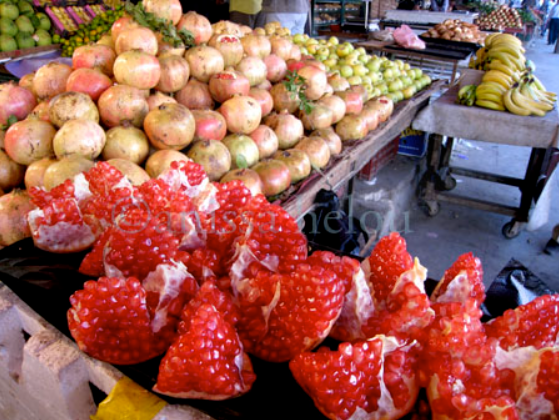
Here is a wonderful display of the sour kind which I came across in a great street market in Aleppo, Syria.
Sadly, I will not be there this pomegranate season, not as long the lion keeps savaging his people!

Share:

Comments

Leave the first comment

<!-- if comments are disabled for this post then hide comments container -->
<style> 
<?php if(!comments_open()) { echo "#nfps-comments-container {display: none !important;}"; }?>
</style>

pomegranates: a myth and how to take the seeds out

15, June

Like figs, pomegranates are the symbol of fertility. Legend has it that Persephone, the daughter of Demeter, the goddess of fruit and fertility, was carried off to the underworld by Pluto. To force Persephones’s release, Demeter prevented plants from bearing fruit thus creating winter which did not exist previously. Persephone also did her bit by going on a hunger strike although she eventually succumbed and ate a pomegranate which she spat out except for 6 seeds. After which Demeter struck a deal with Pluto whereby she agreed that he would keep her daughter for 6 months of the year, one month for each seed, and she would have her for the remaining 6 months. And this is how summer and winter were created with pomegranates starting to ripen towards the end of summer.

They have just started appearing in the Lebanese shops here and very soon, they will be ripening on Mary Taylor Simeti’s trees in Sicily.  We were exchanging emails the other day when she asked what would be the best way to take the seeds out. I said I would post it as I would be eating a lot of pomegranates from now until the end of the season. So, here is what I do which is also what most people in the Middle East do. It is a slow process but it produces totally unblemished seeds without any bits of the bitter pith which spoils the sweet taste of the pomegranate seeds.

Using a sharp knife, cut and discard the top skin off the pomegranate, also the bottom. Then taking the pith line as a marker, cut into the skin to create wedges as if you were cutting to peel an orange. If the middle bit of the pith is very thick, insert the tip of your knife in between it and the seeds and flick it out. Then gently break the pomegranate in half.

Break the halves into wedges and peel each, both the thick outer skin and the thin one covering the seeds before carefully prising the seeds off the pith by pushing them against the direction they are attached to the pith. If you do this slowly and gently, you will not get any juice on your fingers.

This will take some time but you will end up with a beautiful, crisp bowl of jewel-like pomegranate seeds. The one I peeled here has very pale lustrous seeds that are sweet and juicy although not yet at their very best. I expect it will be in another couple of weeks before I can buy perfect ones. Still, it was delicious. I love mixing the seeds with soaked pine nuts — soaking nuts (preferably overnight to allow them enough time to rehydrate) makes them taste as if they are fresh. I will have to try the next batch with wet walnuts which are also in season!

I have tried taking the shorter route of cutting the pomegranate in half and tapping on the skin with a knife to let the seeds drop but I don’t like doing it this way. The seeds are fragile and some of them will bruise. It is also messier with juice spurting out. My slow method is neat, and it also has a serene, meditative quality to it which I like. Anyhow, whichever way you decide to take the seeds out, you will be in for a treat as long as you have bought the right kind of pomegranates. There is a sour or to be more accurate, a sweet-sour pomegranate called leffan in Arabic which is the one used for pomegranate syrup and to garnish baba ghannuge and other dishes.

Here is a wonderful display of the sour kind which I came across in a great street market in Aleppo, Syria.

Sadly, I will not be there this pomegranate season, not as long the lion keeps savaging his people!

Share:

Comments

Leave the first comment

<!-- if comments are disabled for this post then hide comments container -->
<style> 
<?php if(!comments_open()) { echo "#nfps-comments-container {display: none !important;}"; }?>
</style>

pomegranates: a myth and how to take the seeds out

15, June

Like figs, pomegranates are the symbol of fertility. Legend has it that Persephone, the daughter of Demeter, the goddess of fruit and fertility, was carried off to the underworld by Pluto. To force Persephones’s release, Demeter prevented plants from bearing fruit thus creating winter which did not exist previously. Persephone also did her bit by going on a hunger strike although she eventually succumbed and ate a pomegranate which she spat out except for 6 seeds. After which Demeter struck a deal with Pluto whereby she agreed that he would keep her daughter for 6 months of the year, one month for each seed, and she would have her for the remaining 6 months. And this is how summer and winter were created with pomegranates starting to ripen towards the end of summer.

They have just started appearing in the Lebanese shops here and very soon, they will be ripening on Mary Taylor Simeti’s trees in Sicily.  We were exchanging emails the other day when she asked what would be the best way to take the seeds out. I said I would post it as I would be eating a lot of pomegranates from now until the end of the season. So, here is what I do which is also what most people in the Middle East do. It is a slow process but it produces totally unblemished seeds without any bits of the bitter pith which spoils the sweet taste of the pomegranate seeds.

Using a sharp knife, cut and discard the top skin off the pomegranate, also the bottom. Then taking the pith line as a marker, cut into the skin to create wedges as if you were cutting to peel an orange. If the middle bit of the pith is very thick, insert the tip of your knife in between it and the seeds and flick it out. Then gently break the pomegranate in half.

Break the halves into wedges and peel each, both the thick outer skin and the thin one covering the seeds before carefully prising the seeds off the pith by pushing them against the direction they are attached to the pith. If you do this slowly and gently, you will not get any juice on your fingers.

This will take some time but you will end up with a beautiful, crisp bowl of jewel-like pomegranate seeds. The one I peeled here has very pale lustrous seeds that are sweet and juicy although not yet at their very best. I expect it will be in another couple of weeks before I can buy perfect ones. Still, it was delicious. I love mixing the seeds with soaked pine nuts — soaking nuts (preferably overnight to allow them enough time to rehydrate) makes them taste as if they are fresh. I will have to try the next batch with wet walnuts which are also in season!

I have tried taking the shorter route of cutting the pomegranate in half and tapping on the skin with a knife to let the seeds drop but I don’t like doing it this way. The seeds are fragile and some of them will bruise. It is also messier with juice spurting out. My slow method is neat, and it also has a serene, meditative quality to it which I like. Anyhow, whichever way you decide to take the seeds out, you will be in for a treat as long as you have bought the right kind of pomegranates. There is a sour or to be more accurate, a sweet-sour pomegranate called leffan in Arabic which is the one used for pomegranate syrup and to garnish baba ghannuge and other dishes.

Here is a wonderful display of the sour kind which I came across in a great street market in Aleppo, Syria.

Sadly, I will not be there this pomegranate season, not as long the lion keeps savaging his people!

Share:

Comments

Leave the first comment

<!-- if comments are disabled for this post then hide comments container -->
<style> 
<?php if(!comments_open()) { echo "#nfps-comments-container {display: none !important;}"; }?>
</style>