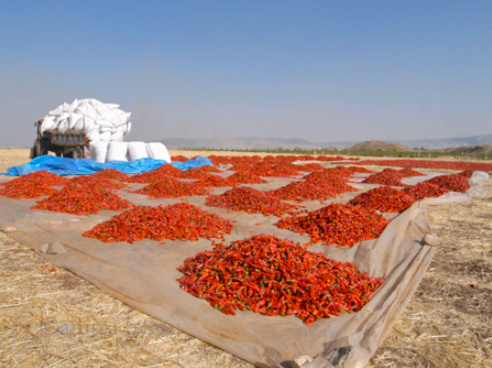
dried peppers

23, June

I still remember that fleeting image of red peppers lining the road as I drove from Izmir back to Istanbul at the end of a fabulous boat trip way back in 1982. I didn’t stop and always regretted not having taken a closer look. So, when I came across a similar scene a couple of weeks back as JasonFiliz and I drove from Gaziantep to Maras, I immediately asked the driver to stop the car.

The set-up was slightly different. The sheets were further away from the road, spread in the middle of the fields, and there were no women working – back then, it was all women, dressed in the typical floral pants, busy spreading fresh peppers or packing already dried ones. This time, they were just men and the sheets were plastic and fairly dark as against the brilliant white cotton ones I saw back then. Still, the work was the same. The men were spreading fresh peppers to dry or gathering the already dried ones to pack into large bags to carry to market.

We drove on to Maras to have our salep ice cream (which by the way, was very disappointing) then we went up into the mountains to visit farmers making cheese. The landscape up there was gorgeous with not a single built house in sight but the conditions in which the peasants lived were incredibly primitive with no running water or electricity. And the structures are all temporary — they move up there from their village for the season. Again plastic had taken over from traditional materials, except for the shower below which was built with the traditional reeds.

primitive shower copy

And on another stretch of the road, on our way to see bastik (grape leather) being made, we came across the following gorgeous structures to dry both aubergines and peppers. As you can see from the clips, some of the aubergines are cored, strung on thin cotton cords and hung between the poles whilst some are diced and spread on sheets on the ground. The cored aubergines are eventually stuffed whereas the diced ones are cooked with rice or burghul. In either case, they need to be re-hydrated before use.

Share:

Comments

Leave the first comment

<!-- if comments are disabled for this post then hide comments container -->
<style> 
<?php if(!comments_open()) { echo "#nfps-comments-container {display: none !important;}"; }?>
</style>

dried peppers

23, June

I still remember that fleeting image of red peppers lining the road as I drove from Izmir back to Istanbul at the end of a fabulous boat trip way back in 1982. I didn’t stop and always regretted not having taken a closer look. So, when I came across a similar scene a couple of weeks back as JasonFiliz and I drove from Gaziantep to Maras, I immediately asked the driver to stop the car.

The set-up was slightly different. The sheets were further away from the road, spread in the middle of the fields, and there were no women working – back then, it was all women, dressed in the typical floral pants, busy spreading fresh peppers or packing already dried ones. This time, they were just men and the sheets were plastic and fairly dark as against the brilliant white cotton ones I saw back then. Still, the work was the same. The men were spreading fresh peppers to dry or gathering the already dried ones to pack into large bags to carry to market.

We drove on to Maras to have our salep ice cream (which by the way, was very disappointing) then we went up into the mountains to visit farmers making cheese. The landscape up there was gorgeous with not a single built house in sight but the conditions in which the peasants lived were incredibly primitive with no running water or electricity. And the structures are all temporary — they move up there from their village for the season. Again plastic had taken over from traditional materials, except for the shower below which was built with the traditional reeds.

primitive shower copy

And on another stretch of the road, on our way to see bastik (grape leather) being made, we came across the following gorgeous structures to dry both aubergines and peppers. As you can see from the clips, some of the aubergines are cored, strung on thin cotton cords and hung between the poles whilst some are diced and spread on sheets on the ground. The cored aubergines are eventually stuffed whereas the diced ones are cooked with rice or burghul. In either case, they need to be re-hydrated before use.

Share:

Comments

Leave the first comment

<!-- if comments are disabled for this post then hide comments container -->
<style> 
<?php if(!comments_open()) { echo "#nfps-comments-container {display: none !important;}"; }?>
</style>

dried peppers

23, June

I still remember that fleeting image of red peppers lining the road as I drove from Izmir back to Istanbul at the end of a fabulous boat trip way back in 1982. I didn’t stop and always regretted not having taken a closer look. So, when I came across a similar scene a couple of weeks back as JasonFiliz and I drove from Gaziantep to Maras, I immediately asked the driver to stop the car.

The set-up was slightly different. The sheets were further away from the road, spread in the middle of the fields, and there were no women working – back then, it was all women, dressed in the typical floral pants, busy spreading fresh peppers or packing already dried ones. This time, they were just men and the sheets were plastic and fairly dark as against the brilliant white cotton ones I saw back then. Still, the work was the same. The men were spreading fresh peppers to dry or gathering the already dried ones to pack into large bags to carry to market.

We drove on to Maras to have our salep ice cream (which by the way, was very disappointing) then we went up into the mountains to visit farmers making cheese. The landscape up there was gorgeous with not a single built house in sight but the conditions in which the peasants lived were incredibly primitive with no running water or electricity. And the structures are all temporary — they move up there from their village for the season. Again plastic had taken over from traditional materials, except for the shower below which was built with the traditional reeds.

primitive shower copy

And on another stretch of the road, on our way to see bastik (grape leather) being made, we came across the following gorgeous structures to dry both aubergines and peppers. As you can see from the clips, some of the aubergines are cored, strung on thin cotton cords and hung between the poles whilst some are diced and spread on sheets on the ground. The cored aubergines are eventually stuffed whereas the diced ones are cooked with rice or burghul. In either case, they need to be re-hydrated before use.

Share:

Comments

Leave the first comment

<!-- if comments are disabled for this post then hide comments container -->
<style> 
<?php if(!comments_open()) { echo "#nfps-comments-container {display: none !important;}"; }?>
</style>