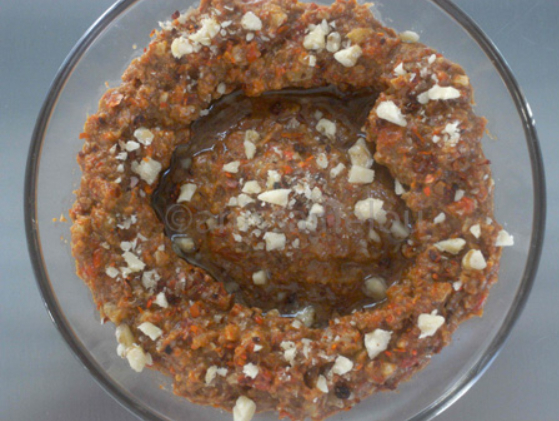
muhammara – a spicy walnut dip

4, June

I wrote my Lebanese cookbook 20 years ago and when I did, I wanted to include a recipe for muhammara except that my mother didn’t have one. I then found a recipe in Ibrahim Mouzannar’s book but it was not like the muhammara I knew and loved — I think he suggests using burghul instead of breadcrumbs. A few months later, I found a good version at a Lebanese shop on Kensington High Street — long gone now — but they wouldn’t part with their recipe! As a result, I never included one in my book. But I kept looking until I finally found three good recipes, the one I give below, a classic Aleppine version which is posted later today on Design Sponge in their ‘In the Kitchen with’ section and a third one which was published in Food & Wine magazine a few years ago and which I had learned from Mohamed Antabli, chef/owner of Al-Waha. The one below is made with grilled peppers and the one on Design Sponge with pepper paste — I bring mine back from Aleppo or Gaziantep but you can find decent commercial pastes in Turkish shops. I sometimes bake mastic-flavoured crackers to serve with my dips and I also give a recipe for them here.

Muhammarah

6 red bell peppers

100 g (1 cup) breadcrumbs

½ tablespoon sugar

1 tbsp cumin

1 tablespoon Aleppo pepper flakes

juice of ½ lemon

1 ½-2 tablespoons pomegranate syrup

3 tablespoons olive oil

½ tablespoon tahini

100 g walnuts, coarsely ground (about ¾ cup), plus extra for garnish

sea salt

Spread the peppers on a baking sheet and place under a hot grill quite close to the heat. Grill for 15-20 minutes on each side until the skin is quite charred and the flesh very soft. Place in a bowl to collect the juices, which you may need later. Then, remove one pepper at a time onto your work surface. Take out the stalk and seeds and peel. Place in a food processor. Trim and peel the remaining peppers and process until chopped finely but not completely pulverised. You want the purée to retain a little texture. Transfer to a mixing bowl.

Add the rest of the ingredients and salt to taste. Mix well. Add a little of the pepper juice if the dip is too thick. It is supposed to be textured and a little thick but not dense. Taste and adjust the seasoning if necessary. Serve drizzled with olive oil and garnished with a few chopped walnuts.

mastic crackers copy

Wholewheat Crackers with Mastic

The taste of the mastic in these crackers is subtle but it comes through nevertheless. It adds an exotic note and is a good combination with the muhammarah. If you can’t find mastic, replace it with cumin or anise seeds or whatever flavour takes your fancy and goes with the dip. Makes 12 medium disks or 48 triangles

150 g (1 cup) wholewheat flour

300 g (2 cups) unbleached all-purpose flour, plus extra for shaping and kneading

2 ¼ teaspoon (1 package) easy bake yeast

1 teaspoon fine sea salt

¼ teaspoon ground mastic

extra virgin olive oil to grease a bowl and to brush crackers

Mix the flours, yeast, salt and mastic in a large mixing bowl and make a well in the centre. Gradually add 1 cup and 2 tablespoons (280 ml) warm water, bringing in the flour as you go along. Knead until you have a rough ball of dough.

Remove the dough onto your lightly floured work surface. Sprinkle with a little flour and knead for 2-3 minutes. Invert the bowl over the dough. Let sit for 15 minutes – this is my version of the professional autolyse where bakers let dough rest to hydrate properly before they kneading it with the leavening. Knead for 3 more minutes, or until the dough is smooth and elastic.

Grease a large bowl with a little olive oil. Shape the dough into a ball and place in the bowl, turning it to coat all over. Cover with plastic wrap. Let rise in a warm, draft-free place for 2 hours. Fold after the first hour. The best way to do this is to invert the bowl gently to receive the ball of dough onto the palm of your hand. Slide it onto your lightly floured work surface and after flouring your hands, gently pat it into a circle. Fold one third over from the top, brushing off any excess flour, then the other third from the bottom. Then do the same from the sides to have a square. Replace the dough in the bowl, with the folded side down and return to rise for another hour. By the end, the dough should have doubled in volume.

  1. Preheat the oven to 240º C.
  2. Remove the dough onto your work surface. Divide in two equal pieces and divide each half into six equal pieces. Roll each into a ball. Cover the balls loosely with cling film. Then take one ball, starting with the first you have shaped, and roll out into a thin circle. With a dough cutter, divide the circle into four triangles. Transfer onto a large non-stick baking sheet and prick all over with a fork – this is done so that the crackers don’t puff up. You can also leave the circles as they are or divide them into long flat strips. Whichever shape you like.
  3. Bake the crackers for 6 to 12 minutes, depending on how thin they are. Remove from the oven. Let cool on a wire rack. Serve at room temperature or store in a hermetically sealed container to serve later. They will keep for a few weeks.

Share:

Comments

Leave the first comment

<!-- if comments are disabled for this post then hide comments container -->
<style> 
<?php if(!comments_open()) { echo "#nfps-comments-container {display: none !important;}"; }?>
</style>

muhammara – a spicy walnut dip

4, June

I wrote my Lebanese cookbook 20 years ago and when I did, I wanted to include a recipe for muhammara except that my mother didn’t have one. I then found a recipe in Ibrahim Mouzannar’s book but it was not like the muhammara I knew and loved — I think he suggests using burghul instead of breadcrumbs. A few months later, I found a good version at a Lebanese shop on Kensington High Street — long gone now — but they wouldn’t part with their recipe! As a result, I never included one in my book. But I kept looking until I finally found three good recipes, the one I give below, a classic Aleppine version which is posted later today on Design Sponge in their ‘In the Kitchen with’ section and a third one which was published in Food & Wine magazine a few years ago and which I had learned from Mohamed Antabli, chef/owner of Al-Waha. The one below is made with grilled peppers and the one on Design Sponge with pepper paste — I bring mine back from Aleppo or Gaziantep but you can find decent commercial pastes in Turkish shops. I sometimes bake mastic-flavoured crackers to serve with my dips and I also give a recipe for them here.

Muhammarah

6 red bell peppers

100 g (1 cup) breadcrumbs

½ tablespoon sugar

1 tbsp cumin

1 tablespoon Aleppo pepper flakes

juice of ½ lemon

1 ½-2 tablespoons pomegranate syrup

3 tablespoons olive oil

½ tablespoon tahini

100 g walnuts, coarsely ground (about ¾ cup), plus extra for garnish

sea salt

Spread the peppers on a baking sheet and place under a hot grill quite close to the heat. Grill for 15-20 minutes on each side until the skin is quite charred and the flesh very soft. Place in a bowl to collect the juices, which you may need later. Then, remove one pepper at a time onto your work surface. Take out the stalk and seeds and peel. Place in a food processor. Trim and peel the remaining peppers and process until chopped finely but not completely pulverised. You want the purée to retain a little texture. Transfer to a mixing bowl.

Add the rest of the ingredients and salt to taste. Mix well. Add a little of the pepper juice if the dip is too thick. It is supposed to be textured and a little thick but not dense. Taste and adjust the seasoning if necessary. Serve drizzled with olive oil and garnished with a few chopped walnuts.

mastic crackers copy

Wholewheat Crackers with Mastic

The taste of the mastic in these crackers is subtle but it comes through nevertheless. It adds an exotic note and is a good combination with the muhammarah. If you can’t find mastic, replace it with cumin or anise seeds or whatever flavour takes your fancy and goes with the dip. Makes 12 medium disks or 48 triangles

150 g (1 cup) wholewheat flour

300 g (2 cups) unbleached all-purpose flour, plus extra for shaping and kneading

2 ¼ teaspoon (1 package) easy bake yeast

1 teaspoon fine sea salt

¼ teaspoon ground mastic

extra virgin olive oil to grease a bowl and to brush crackers

Mix the flours, yeast, salt and mastic in a large mixing bowl and make a well in the centre. Gradually add 1 cup and 2 tablespoons (280 ml) warm water, bringing in the flour as you go along. Knead until you have a rough ball of dough.

Remove the dough onto your lightly floured work surface. Sprinkle with a little flour and knead for 2-3 minutes. Invert the bowl over the dough. Let sit for 15 minutes – this is my version of the professional autolyse where bakers let dough rest to hydrate properly before they kneading it with the leavening. Knead for 3 more minutes, or until the dough is smooth and elastic.

Grease a large bowl with a little olive oil. Shape the dough into a ball and place in the bowl, turning it to coat all over. Cover with plastic wrap. Let rise in a warm, draft-free place for 2 hours. Fold after the first hour. The best way to do this is to invert the bowl gently to receive the ball of dough onto the palm of your hand. Slide it onto your lightly floured work surface and after flouring your hands, gently pat it into a circle. Fold one third over from the top, brushing off any excess flour, then the other third from the bottom. Then do the same from the sides to have a square. Replace the dough in the bowl, with the folded side down and return to rise for another hour. By the end, the dough should have doubled in volume.

  1. Preheat the oven to 240º C.
  2. Remove the dough onto your work surface. Divide in two equal pieces and divide each half into six equal pieces. Roll each into a ball. Cover the balls loosely with cling film. Then take one ball, starting with the first you have shaped, and roll out into a thin circle. With a dough cutter, divide the circle into four triangles. Transfer onto a large non-stick baking sheet and prick all over with a fork – this is done so that the crackers don’t puff up. You can also leave the circles as they are or divide them into long flat strips. Whichever shape you like.
  3. Bake the crackers for 6 to 12 minutes, depending on how thin they are. Remove from the oven. Let cool on a wire rack. Serve at room temperature or store in a hermetically sealed container to serve later. They will keep for a few weeks.

Share:

Comments

Leave the first comment

<!-- if comments are disabled for this post then hide comments container -->
<style> 
<?php if(!comments_open()) { echo "#nfps-comments-container {display: none !important;}"; }?>
</style>

muhammara – a spicy walnut dip

4, June

I wrote my Lebanese cookbook 20 years ago and when I did, I wanted to include a recipe for muhammara except that my mother didn’t have one. I then found a recipe in Ibrahim Mouzannar’s book but it was not like the muhammara I knew and loved — I think he suggests using burghul instead of breadcrumbs. A few months later, I found a good version at a Lebanese shop on Kensington High Street — long gone now — but they wouldn’t part with their recipe! As a result, I never included one in my book. But I kept looking until I finally found three good recipes, the one I give below, a classic Aleppine version which is posted later today on Design Sponge in their ‘In the Kitchen with’ section and a third one which was published in Food & Wine magazine a few years ago and which I had learned from Mohamed Antabli, chef/owner of Al-Waha. The one below is made with grilled peppers and the one on Design Sponge with pepper paste — I bring mine back from Aleppo or Gaziantep but you can find decent commercial pastes in Turkish shops. I sometimes bake mastic-flavoured crackers to serve with my dips and I also give a recipe for them here.

Muhammarah

6 red bell peppers

100 g (1 cup) breadcrumbs

½ tablespoon sugar

1 tbsp cumin

1 tablespoon Aleppo pepper flakes

juice of ½ lemon

1 ½-2 tablespoons pomegranate syrup

3 tablespoons olive oil

½ tablespoon tahini

100 g walnuts, coarsely ground (about ¾ cup), plus extra for garnish

sea salt

Spread the peppers on a baking sheet and place under a hot grill quite close to the heat. Grill for 15-20 minutes on each side until the skin is quite charred and the flesh very soft. Place in a bowl to collect the juices, which you may need later. Then, remove one pepper at a time onto your work surface. Take out the stalk and seeds and peel. Place in a food processor. Trim and peel the remaining peppers and process until chopped finely but not completely pulverised. You want the purée to retain a little texture. Transfer to a mixing bowl.

Add the rest of the ingredients and salt to taste. Mix well. Add a little of the pepper juice if the dip is too thick. It is supposed to be textured and a little thick but not dense. Taste and adjust the seasoning if necessary. Serve drizzled with olive oil and garnished with a few chopped walnuts.

mastic crackers copy

Wholewheat Crackers with Mastic

The taste of the mastic in these crackers is subtle but it comes through nevertheless. It adds an exotic note and is a good combination with the muhammarah. If you can’t find mastic, replace it with cumin or anise seeds or whatever flavour takes your fancy and goes with the dip. Makes 12 medium disks or 48 triangles

150 g (1 cup) wholewheat flour

300 g (2 cups) unbleached all-purpose flour, plus extra for shaping and kneading

2 ¼ teaspoon (1 package) easy bake yeast

1 teaspoon fine sea salt

¼ teaspoon ground mastic

extra virgin olive oil to grease a bowl and to brush crackers

Mix the flours, yeast, salt and mastic in a large mixing bowl and make a well in the centre. Gradually add 1 cup and 2 tablespoons (280 ml) warm water, bringing in the flour as you go along. Knead until you have a rough ball of dough.

Remove the dough onto your lightly floured work surface. Sprinkle with a little flour and knead for 2-3 minutes. Invert the bowl over the dough. Let sit for 15 minutes – this is my version of the professional autolyse where bakers let dough rest to hydrate properly before they kneading it with the leavening. Knead for 3 more minutes, or until the dough is smooth and elastic.

Grease a large bowl with a little olive oil. Shape the dough into a ball and place in the bowl, turning it to coat all over. Cover with plastic wrap. Let rise in a warm, draft-free place for 2 hours. Fold after the first hour. The best way to do this is to invert the bowl gently to receive the ball of dough onto the palm of your hand. Slide it onto your lightly floured work surface and after flouring your hands, gently pat it into a circle. Fold one third over from the top, brushing off any excess flour, then the other third from the bottom. Then do the same from the sides to have a square. Replace the dough in the bowl, with the folded side down and return to rise for another hour. By the end, the dough should have doubled in volume.

  1. Preheat the oven to 240º C.
  2. Remove the dough onto your work surface. Divide in two equal pieces and divide each half into six equal pieces. Roll each into a ball. Cover the balls loosely with cling film. Then take one ball, starting with the first you have shaped, and roll out into a thin circle. With a dough cutter, divide the circle into four triangles. Transfer onto a large non-stick baking sheet and prick all over with a fork – this is done so that the crackers don’t puff up. You can also leave the circles as they are or divide them into long flat strips. Whichever shape you like.
  3. Bake the crackers for 6 to 12 minutes, depending on how thin they are. Remove from the oven. Let cool on a wire rack. Serve at room temperature or store in a hermetically sealed container to serve later. They will keep for a few weeks.

Share:

Comments

Leave the first comment

<!-- if comments are disabled for this post then hide comments container -->
<style> 
<?php if(!comments_open()) { echo "#nfps-comments-container {display: none !important;}"; }?>
</style>