

It’s nearly forty years since I left Lebanon. There were many things that I hated about Beirut and many that I loved. I still feel the same although much of what I loved is disappearing, like the ambulant vegetable and fruit vendors who sell their produce off wooden carts which they push through neighbourhoods while shouting out their wares. A guy like the sombrero-wearing man below would belt out “yalla ‘ala banadurah, yalla ‘ala khiyar” to let everyone know he had tomatoes and cucumbers which he may have just picked from his fields. I loved listening to their cries and always followed my mother onto the balcony to watch her bargain with the vendor to get the best possible price.

Fortunately there are still some neighbourhoods (mostly the poorer ones) with ambulant vendors and last year I had a lovely surprise when my charming driver, Jamil who sadly is no longer with us, drove me on the way to the Iranian embassy through a stretch of Ouzayih in West Beirut that was lined with fruit and vegetable carts. Some had the produce piled high with no particular attention to aesthetics while others had very neat displays. I asked Jamil to stop and we went down, him to check the prices — he had a wonderful garden where he grew organic produce which my mother and other neighbours bought from him — and me to take pictures.

This was last year and I can only imagine what the place is like during Ramadan. There must be twice as many carts to cater for the nightly feasts that home cooks prepare for breaking the fast. One dish that is always present at Iftar (the first meal to break the fast) in both Lebanon and Syria is fattush, a mixed herbs and toasted bread salad. And it happens to be one of my favourite salads. There are endless variations. Some people use stale bread instead of toasted. Others add green peppers which I object to because the flavour is too strong. I have even seen it made with cabbage down in Tyre.
The dressing also varies but it will always have sumac, a lemony berry that is dried on the branch, then ground. I was lucky on a separate trip to be travelling with Jason Lowe during sumac season in May and here is a picture he took at a vegetable stall on our way back to Beirut from the south where I had spotted sumac being sold on the branch.

It is rare to see sumac sold like this. Usually it is sold already ground or with the berries rubbed off the branch. When whole, the sumac berries are soaked in water and the tart juice is used to make the sauce for kibbeh summaqiyeh, a speciality of Aleppo or the juice is used to season fattush. In fact, a friend who owns Al Falamanki in Beirut insists that it is the only way to season fattush. I don’t agree and I prefer to use ground sumac because by not adding any liquid, the salad stays crisp longer.
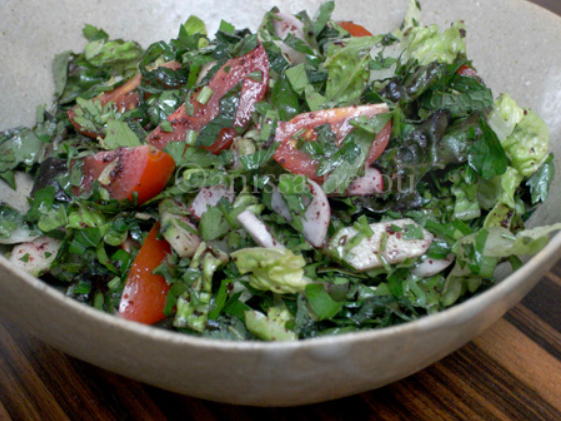
Anyhow, I have two ways of making fattush. One which I learned from my mother where I keep the parsley, mint and purslane leaves whole, and only chop the vegetables while in the other version, which I learned from a friend’s mother, I chop everything apart from the purslane and I add shredded lettuce. This is the version I made today but because I shopped at Waitrose, the mint is coarser than the one I buy in Middle Eastern stores and their organic cucumbers have a very thick skin which needs peeling. And they have yet to start selling purslane. So, no purslane. And no bread. Not because I don’t have good pita in my freezer but because I am permanently on a diet and very rarely put bread in my fattush.


I don’t vary the seasoning though and always use ground sumac, olive oil and salt. And this is when you need to bring out your best olive oil as you will really taste it in the salad. Also make sure to use good sumac. Some of it is mixed with salt or ground with bits of branch to bulk it up. I always bring back mine from either Syria (sadly, this won’t be for a while) or Lebanon. My last batch was particularly excellent! I think it came from Hilali in the souk of Aleppo. Or perhaps it was sent to me by my mother.

Fattush
Mixed Herbs and Toasted Bread Salad
This is my friend’s mother’s version which is my favourite now. Serves 4-6
1 medium pita bread, opened up at the seam to have two disks, toasted until golden brown and broken into bite-sized pieces
3 tablespoons sumac
6 tablespoons extra virgin olive oil
400 g gem lettuce, outer damaged leaves discarded, cut across in 1 cm strips
100 g spring onions, trimmed and thinly sliced
300 g mini cucmbers, sliced in medium-thin half circles
300 g firm red tomatoes, chopped into bite-sized pieces
200 g flat-leaf parsley, most of the stalks discarded, coarsely chopped
100 g mint, leaves only, coarsely chopped
100 g purslane, leaves only
sea salt
Put the broken up toasted bread in a medium bowl. Sprinkle the sumac all over. Add the oil and mix well. This should stop the bread from sogging up quickly once it is mixed with the salad.
Put the salad ingredients in a large salad bowl. Add salt to taste. Add the seasoned bread. Mix well. Taste and adjust the seasoning if necessary. Serve immediately.
©anissa helou
My mother’s Fattush
Serves 4-6
2 medium round pita bread
3 tablespoons sumac
5 tablespoons extra virgin oil
1 tablespoon chilli oil (optional)
200 g flat parsley, washed, dried and leaves picked off stalks
100 g mint, leaves picked off stalks
100 g purslane, leaves picked off stalks
100 g spring onions, trimmed and thinly sliced
350 g small cucumbers, thinly sliced in half circles
100 g medium red radishes, thinly sliced in half circles
300 g cherry tomatoes, quartered
salt to taste
juice of 1/2 lemon, or to taste
Tear the pita bread open and toast it under a hot grill or in an oven until golden brown. Place on a rack to cool. Break the toasted bread into bite-sized pieces and put in a salad bowl. Sprinkle with sumac, add the oil and mix until the bread is thoroughly coated.
Add the remaining ingredients, salt to taste and the lemon juice and mix well together. Taste, adjust seasoning if necessary and serve immediately.
©anissa helou

