

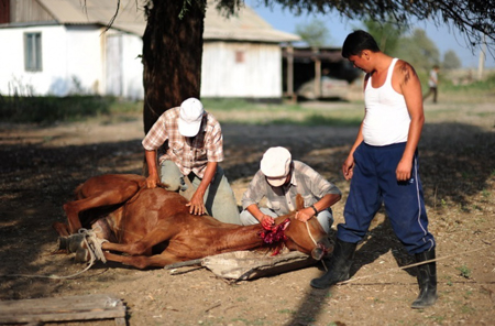
I have appropriated this amazing picture and the one further down from a Russian blog post to which I have linked below. I would have liked to acknowledge the photographer but as I said, I don’t read Russian and can’t understand who to credit. Sorry.
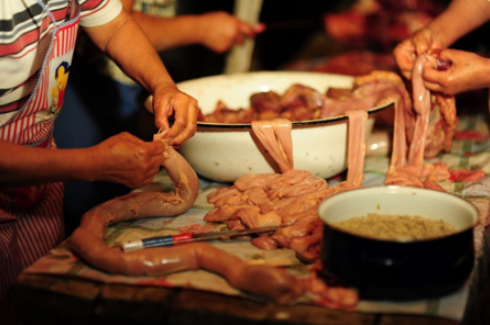
Anissa: It has been a very long time since Charles Perry did a guest post here. He’s been ‘unusually busy’ (his words). Still, he has just sent me this very interesting post on eating horse meat. We didn’t have pictures which is not surprising. Charles lives in LA and I in London with no boucherie chevaline anywhere to be seen. Fortunately, I have the most wonderful friend, Victoria, who found me this Russian blog post where they show the whole process, from catching the horse, to killing it, butchering it and finally preparing the meat and sausages. The photos are pretty amazing. I assume they were done by a professional photographer or a very good amateur one. I can’t tell as I don’t understand Russian and google translate wouldn’t translate the page for me. It just went to another page. Anyhow, here is Charles’ fascinating post together with a recipe that calls for smoked horse meat sausage! I actually tasted it once, thanks to Bob Chenciner who has strong connections in Daghestan and who has written about it. He had some at home one day I was visiting and he gave me a taste. It was strong and fatty but very tasty and it may have been the karta Charles mentions below. Must check with him.
Charles: Many cultures don’t approve of eating horse flesh. To Jews, it’s not kosher because the horse doesn’t chew a cud and its hoof isn’t cloven. The Romans despised eating horse meat, and Christian authorities ultimately opposed it too, though Iceland got an exemption during the Middle Ages because its agriculture was so marginal. (Icelanders still eat horse.) By the 17th century, Europe’s problem with horse meat had gone from religious opposition to a feeling that it was just a low-class food, something eaten only by the unscrupulous or the desperately poor. Outside France, you rarely see a horse butcher in Europe today.
Though horse meat is not actually forbidden in Islam, Muhammad himself did not eat it, and neither do most Muslims. But it’s pointless to oppose hippophagy in Central Asia, where people have lots of horses and sometimes not much else. The Mongols and fellow nomads such as the Kazakhs eat whatever animals they herd, and there are some who herd nothing but horses. So there’s a horse-based cuisine, which includes the surprisingly tasty karta, a sausage of layers of horse liver and horse belly fat rolled up roly-poly fashion. It regularly appears on appetizer platters.
In the late ’80s, somebody in the former Soviet Union had the bright idea of publishing a lavish color-illustrated book titled “National Cuisine of the Kazakhs,” along the lines of “Italy the Beautiful” and such books of the period. This might have been the most poorly conceived coffee-table book ever; Kazakh food is hearty but not even remotely photogenic. Photo after photo showed a crude chunk of meat (often looking slightly scorched) surrounded by fussy food-stylist tchotchkes — flowers, dolls, Chinese bowls, carved wooden spoons, colorful folk fabrics, etc. The total effect was so brutal and incongruous that the book could have been made up by vegetarians as anti-meat propaganda.
It included a diagram of the cuts of the horse as the Kazakhs butcher them out. They’re roughly the same cuts that you’d get from a sheep or a cow (shoulder, ribs, leg, etc.), except that there’s a particularly delectable bit in the hind leg called zhaya and a polliwog-shaped lump of fat under the mane (the zhal), both of which are salted, smoked and served cold.
Zhaya Palaw
650 g zhaya or any smoked horse meat sausage
water
200 g clarified butter
150 g chopped onion
240 g julienne carrot
240 g julienne black radish
470 g rice
1/2 teaspoon salt
1/4 teaspoon ground red pepper
6 sprigs green coriander
Boil the zhaya or sausage until done. Set aside.
Melt the butter in a 2-liter saucepan and fry the onion, carrot and black radish until softened. Stir in the rice, salt and red pepper and add water to cover by the depth of two finger joints. Bring to the boil, reduce the heat to medium and cook until the water is absorbed.
Cover the saucepan with a clean dish towel and set the lid over it. Reduce the heat to low and steam the rice 20-30 minutes.
While the pilaf is cooking, cut the zhaya or sausage into slices. To serve, garnish the pilaf with the meat and the sprigs of coriander.
Anissa: Well, all there is left for me to do now is to plan a trip to Kazakhstan later in the year, hoping to find a family like the one in the Russian blog post with whom I can feast on horse flesh!

