natef: a miraculous transformation

23, June

Long before the wonderful Alan Davidson died, I embarked, together with Helen Saberi and Esteban Pombo Villar, on the most marvellous adventure under Alan’s aegis, trying to elucidate the mysteries of natef, a white soft meringue-like dip made with an unlikely ingredient (dessicated roots that look like dead wood) which is served with karabij Halab (semolina cookies filled with either pistachios in Lebanon or walnuts in Aleppo).

I was writing Lebanese Cuisine then and I had brought some of the root with me from Beirut to test the recipe but I had two conflicting bits of information regarding the root which is known as shirsh el-halaweh in Arabic. Some people refer to it as ‘erq al-halaweh. Claudia Roden describes it as bois de Panama in her Middle Eastern cookbook and the late Ibrahim Mouzannar, one of my favourite authors on Lebanese food, has it as soapwort in his Lebanese cookbook. You can actually read the full investigation of our Interspi (spi for spices) in the Wilder Shores of Gastronomy or in PPC. I will not repeat the information here but I will show you in pictures how natef is made, just in case you can get some and want to experiment. I, for one, am hoping that Australian customs will let me bring in my 1 ½ kilograms of shirsh el-halaweh for my demonstration of natef & karabij during the World Chef Showcase programme in Sydney on 10 October.

So, here goes. You start with the very unpromising roots of Saponaria officinalis which have saponin — in fact, the same roots are also used to wash carpets — which you need to rinse well to get rid of the last bits of earth clinging to them. Then you put these to boil in water (exact recipe below) until the water is reduced by three quarters. As the water reduces, it changes colour and becomes brown. Looking at it, you would never believe it will eventually turn into the most brilliant white foam. But it does!

After  you have whisked the water into a white foam, you start adding, slowly, a slightly thicker sugar syrup than normal (sorry, I missed photographing this step; was too busy concentrating on incorporating the syrup and hoping not to mess up). As you add the syrup, the white foam expands to more than double its volume and becomes glossy.

h-natef-pouring copy

I think this is where I have still to master the dip completely. When I asked the lovely owners at Amal Bohsali (my favourite sweet-maker in Beirut) how they made their natef, they gave me a recipe where the syrup is made with glucose, which Mr Ghazi, the father, said makes the dip firmer. I have not yet tried it with glucose but my friend Victoria at Bois de Jasmin will and I or she will report back in due course on her natef. For now, I have only used sugar in the syrup and my natef separates the next day, with the foam staying on top and most of the syrup settling on the bottom whereas the commercially made one stays as it is for a few days.

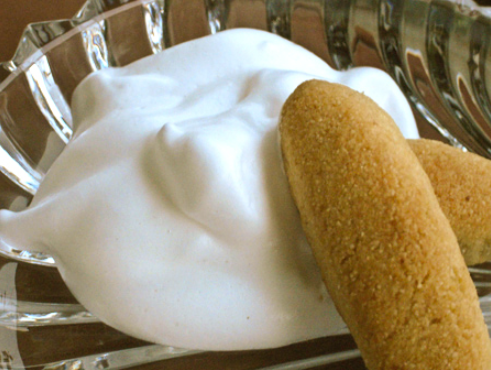
Still, the recipe as it stands works very well (as you can see from the picture) as long as you serve it on the day you make it. As for the karabij, I will post a recipe and pictures in the next few days.

natef-close up copy

Natef

Makes 500 g

60 g soapwort root

600 ml water

For the syrup

350 g sugar

100 ml water

1 teaspoon lemon juice

1 tablespoon rose water

1 tablespoon orange blossom water

Rinse the soapwort under cold water to clean it from the earth that is still clinging to it. Put in a pan together with the water. Place over a medium heat and bring to a boil. Watch the soapwort as it comes to the boil as it will foam up and may boil over. Simmer until the liquid is reduced by three quarters. You should be left with 150 ml of the water, which by then will have become brown.

While the soapwort is simmering, prepare the syrup. Put the water, sugar and lemon juice in a pan and bring to a boil over a medium heat, stirring occasionally. Let boil for 3 minutes then add the fragrant waters. Mix well. Take off the heat.

Strain the soapwort liquid into a large mixing bowl and, using an electric beater, whisk until the water has become a white, rather shiny foam – rather unbelievable but true. The miraculous transformation is due to the saponin in the soapwort.

Gradually add the sugar syrup to the foam as the beater is still whisking until you have used it all up and you have a fluffy, stretchy dip/sauce – you can use a little less syrup if you want your dip less sweet.

Share:

Comments

Leave the first comment

<!-- if comments are disabled for this post then hide comments container -->
<style> 
<?php if(!comments_open()) { echo "#nfps-comments-container {display: none !important;}"; }?>
</style>

natef: a miraculous transformation

23, June

Long before the wonderful Alan Davidson died, I embarked, together with Helen Saberi and Esteban Pombo Villar, on the most marvellous adventure under Alan’s aegis, trying to elucidate the mysteries of natef, a white soft meringue-like dip made with an unlikely ingredient (dessicated roots that look like dead wood) which is served with karabij Halab (semolina cookies filled with either pistachios in Lebanon or walnuts in Aleppo).

I was writing Lebanese Cuisine then and I had brought some of the root with me from Beirut to test the recipe but I had two conflicting bits of information regarding the root which is known as shirsh el-halaweh in Arabic. Some people refer to it as ‘erq al-halaweh. Claudia Roden describes it as bois de Panama in her Middle Eastern cookbook and the late Ibrahim Mouzannar, one of my favourite authors on Lebanese food, has it as soapwort in his Lebanese cookbook. You can actually read the full investigation of our Interspi (spi for spices) in the Wilder Shores of Gastronomy or in PPC. I will not repeat the information here but I will show you in pictures how natef is made, just in case you can get some and want to experiment. I, for one, am hoping that Australian customs will let me bring in my 1 ½ kilograms of shirsh el-halaweh for my demonstration of natef & karabij during the World Chef Showcase programme in Sydney on 10 October.

So, here goes. You start with the very unpromising roots of Saponaria officinalis which have saponin — in fact, the same roots are also used to wash carpets — which you need to rinse well to get rid of the last bits of earth clinging to them. Then you put these to boil in water (exact recipe below) until the water is reduced by three quarters. As the water reduces, it changes colour and becomes brown. Looking at it, you would never believe it will eventually turn into the most brilliant white foam. But it does!

After  you have whisked the water into a white foam, you start adding, slowly, a slightly thicker sugar syrup than normal (sorry, I missed photographing this step; was too busy concentrating on incorporating the syrup and hoping not to mess up). As you add the syrup, the white foam expands to more than double its volume and becomes glossy.

h-natef-pouring copy

I think this is where I have still to master the dip completely. When I asked the lovely owners at Amal Bohsali (my favourite sweet-maker in Beirut) how they made their natef, they gave me a recipe where the syrup is made with glucose, which Mr Ghazi, the father, said makes the dip firmer. I have not yet tried it with glucose but my friend Victoria at Bois de Jasmin will and I or she will report back in due course on her natef. For now, I have only used sugar in the syrup and my natef separates the next day, with the foam staying on top and most of the syrup settling on the bottom whereas the commercially made one stays as it is for a few days.

Still, the recipe as it stands works very well (as you can see from the picture) as long as you serve it on the day you make it. As for the karabij, I will post a recipe and pictures in the next few days.

natef-close up copy

Natef

Makes 500 g

60 g soapwort root

600 ml water

For the syrup

350 g sugar

100 ml water

1 teaspoon lemon juice

1 tablespoon rose water

1 tablespoon orange blossom water

Rinse the soapwort under cold water to clean it from the earth that is still clinging to it. Put in a pan together with the water. Place over a medium heat and bring to a boil. Watch the soapwort as it comes to the boil as it will foam up and may boil over. Simmer until the liquid is reduced by three quarters. You should be left with 150 ml of the water, which by then will have become brown.

While the soapwort is simmering, prepare the syrup. Put the water, sugar and lemon juice in a pan and bring to a boil over a medium heat, stirring occasionally. Let boil for 3 minutes then add the fragrant waters. Mix well. Take off the heat.

Strain the soapwort liquid into a large mixing bowl and, using an electric beater, whisk until the water has become a white, rather shiny foam – rather unbelievable but true. The miraculous transformation is due to the saponin in the soapwort.

Gradually add the sugar syrup to the foam as the beater is still whisking until you have used it all up and you have a fluffy, stretchy dip/sauce – you can use a little less syrup if you want your dip less sweet.

Share:

Comments

Leave the first comment

<!-- if comments are disabled for this post then hide comments container -->
<style> 
<?php if(!comments_open()) { echo "#nfps-comments-container {display: none !important;}"; }?>
</style>

natef: a miraculous transformation

23, June

Long before the wonderful Alan Davidson died, I embarked, together with Helen Saberi and Esteban Pombo Villar, on the most marvellous adventure under Alan’s aegis, trying to elucidate the mysteries of natef, a white soft meringue-like dip made with an unlikely ingredient (dessicated roots that look like dead wood) which is served with karabij Halab (semolina cookies filled with either pistachios in Lebanon or walnuts in Aleppo).

I was writing Lebanese Cuisine then and I had brought some of the root with me from Beirut to test the recipe but I had two conflicting bits of information regarding the root which is known as shirsh el-halaweh in Arabic. Some people refer to it as ‘erq al-halaweh. Claudia Roden describes it as bois de Panama in her Middle Eastern cookbook and the late Ibrahim Mouzannar, one of my favourite authors on Lebanese food, has it as soapwort in his Lebanese cookbook. You can actually read the full investigation of our Interspi (spi for spices) in the Wilder Shores of Gastronomy or in PPC. I will not repeat the information here but I will show you in pictures how natef is made, just in case you can get some and want to experiment. I, for one, am hoping that Australian customs will let me bring in my 1 ½ kilograms of shirsh el-halaweh for my demonstration of natef & karabij during the World Chef Showcase programme in Sydney on 10 October.

So, here goes. You start with the very unpromising roots of Saponaria officinalis which have saponin — in fact, the same roots are also used to wash carpets — which you need to rinse well to get rid of the last bits of earth clinging to them. Then you put these to boil in water (exact recipe below) until the water is reduced by three quarters. As the water reduces, it changes colour and becomes brown. Looking at it, you would never believe it will eventually turn into the most brilliant white foam. But it does!

After  you have whisked the water into a white foam, you start adding, slowly, a slightly thicker sugar syrup than normal (sorry, I missed photographing this step; was too busy concentrating on incorporating the syrup and hoping not to mess up). As you add the syrup, the white foam expands to more than double its volume and becomes glossy.

h-natef-pouring copy

I think this is where I have still to master the dip completely. When I asked the lovely owners at Amal Bohsali (my favourite sweet-maker in Beirut) how they made their natef, they gave me a recipe where the syrup is made with glucose, which Mr Ghazi, the father, said makes the dip firmer. I have not yet tried it with glucose but my friend Victoria at Bois de Jasmin will and I or she will report back in due course on her natef. For now, I have only used sugar in the syrup and my natef separates the next day, with the foam staying on top and most of the syrup settling on the bottom whereas the commercially made one stays as it is for a few days.

Still, the recipe as it stands works very well (as you can see from the picture) as long as you serve it on the day you make it. As for the karabij, I will post a recipe and pictures in the next few days.

natef-close up copy

Natef

Makes 500 g

60 g soapwort root

600 ml water

For the syrup

350 g sugar

100 ml water

1 teaspoon lemon juice

1 tablespoon rose water

1 tablespoon orange blossom water

Rinse the soapwort under cold water to clean it from the earth that is still clinging to it. Put in a pan together with the water. Place over a medium heat and bring to a boil. Watch the soapwort as it comes to the boil as it will foam up and may boil over. Simmer until the liquid is reduced by three quarters. You should be left with 150 ml of the water, which by then will have become brown.

While the soapwort is simmering, prepare the syrup. Put the water, sugar and lemon juice in a pan and bring to a boil over a medium heat, stirring occasionally. Let boil for 3 minutes then add the fragrant waters. Mix well. Take off the heat.

Strain the soapwort liquid into a large mixing bowl and, using an electric beater, whisk until the water has become a white, rather shiny foam – rather unbelievable but true. The miraculous transformation is due to the saponin in the soapwort.

Gradually add the sugar syrup to the foam as the beater is still whisking until you have used it all up and you have a fluffy, stretchy dip/sauce – you can use a little less syrup if you want your dip less sweet.

Share:

Comments

Leave the first comment

<!-- if comments are disabled for this post then hide comments container -->
<style> 
<?php if(!comments_open()) { echo "#nfps-comments-container {display: none !important;}"; }?>
</style>