hair pastry or qataifi

24, June

Well, there had to be a redeeming feature. The boutique hotel we had just arrived in in Gaziantep was awful, a little like an Ottoman Adams house. Everything had an abandoned and dusty feel, even the dug up lane leading to it. Still, there was one advantage. I had spotted a qataifi (or sha’r in Arabic, meaning hair) maker right opposite. So, we decided to escape and go there to see how the pastry was made.

I had seen the pastry made in Syria where the production is partly automated. The batter is poured into a long horizontal funnel with tiny holes along the bottom and at the switch of a button, the funnel which is fitted on an electric handle turns over the hot plate dropping the batter in thin parallel lines. I was curious to see if the Turks made it any differently although I didn’t expect to see it all made by hand with the help of a small rather beautiful metal container fitted with a row of mini funnels on the bottom.

hair pastry-cup 2 copy

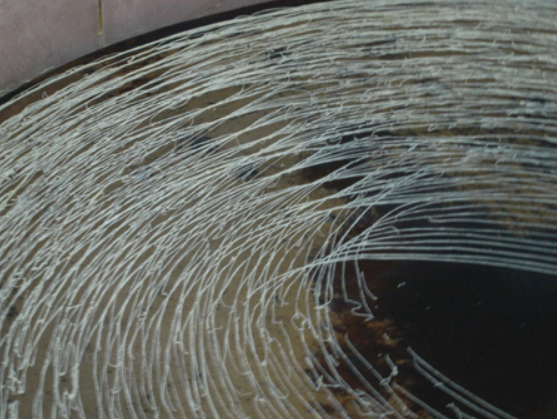
The pastry maker holds the cup using one finger to block the holes — as you can see you need long fingers- and once he’s poured the batter in the cup, he releases his finger and with amazing speed and precision, rotates the cup round and round over the hot metal plate, dropping the finest strands of batter which sizzle as soon as they touch the plate. He overlaps each row as he moves the cup inwards, making pretty loops, until he eventually covers most of the plate. Then, with a deft movement, he picks up the strands of pastry and starts again. Here is a little clip of the qataifi maker at work.https://web.archive.org/web/20160325123626if_/http://player.vimeo.com/video/12684038?title=1&byline=1&portrait=0&fullscreen=1

The pastry is used to make kunafah (different in Turkey from Lebanon but I will reserve this information for another post!), borma where the pastry is rolled around pistachios (again two versions, Lebanese/Syrian and Turkish) and ‘esmalliyeh (a wonderful clotted cream pie). I have also had it used in savoury preparations, notably at Il Convivio in Rome where the chef wrapped it around brains and fried it. Amazing.

And the good news was that we were able to move hotels the very next day to happily ensconce ourselves in Anadolu Evleri where I stay normally. We missed our pastry maker but we had Imam Cagdas with his fabulous baklava, lahmacun and kebabs right next door. Life was good, if only for two days!

Share:

Comments

Leave the first comment

<!-- if comments are disabled for this post then hide comments container -->
<style> 
<?php if(!comments_open()) { echo "#nfps-comments-container {display: none !important;}"; }?>
</style>

hair pastry or qataifi

24, June

Well, there had to be a redeeming feature. The boutique hotel we had just arrived in in Gaziantep was awful, a little like an Ottoman Adams house. Everything had an abandoned and dusty feel, even the dug up lane leading to it. Still, there was one advantage. I had spotted a qataifi (or sha’r in Arabic, meaning hair) maker right opposite. So, we decided to escape and go there to see how the pastry was made.

I had seen the pastry made in Syria where the production is partly automated. The batter is poured into a long horizontal funnel with tiny holes along the bottom and at the switch of a button, the funnel which is fitted on an electric handle turns over the hot plate dropping the batter in thin parallel lines. I was curious to see if the Turks made it any differently although I didn’t expect to see it all made by hand with the help of a small rather beautiful metal container fitted with a row of mini funnels on the bottom.

hair pastry-cup 2 copy

The pastry maker holds the cup using one finger to block the holes — as you can see you need long fingers- and once he’s poured the batter in the cup, he releases his finger and with amazing speed and precision, rotates the cup round and round over the hot metal plate, dropping the finest strands of batter which sizzle as soon as they touch the plate. He overlaps each row as he moves the cup inwards, making pretty loops, until he eventually covers most of the plate. Then, with a deft movement, he picks up the strands of pastry and starts again. Here is a little clip of the qataifi maker at work.https://web.archive.org/web/20160325123626if_/http://player.vimeo.com/video/12684038?title=1&byline=1&portrait=0&fullscreen=1

The pastry is used to make kunafah (different in Turkey from Lebanon but I will reserve this information for another post!), borma where the pastry is rolled around pistachios (again two versions, Lebanese/Syrian and Turkish) and ‘esmalliyeh (a wonderful clotted cream pie). I have also had it used in savoury preparations, notably at Il Convivio in Rome where the chef wrapped it around brains and fried it. Amazing.

And the good news was that we were able to move hotels the very next day to happily ensconce ourselves in Anadolu Evleri where I stay normally. We missed our pastry maker but we had Imam Cagdas with his fabulous baklava, lahmacun and kebabs right next door. Life was good, if only for two days!

Share:

Comments

Leave the first comment

<!-- if comments are disabled for this post then hide comments container -->
<style> 
<?php if(!comments_open()) { echo "#nfps-comments-container {display: none !important;}"; }?>
</style>

hair pastry or qataifi

24, June

Well, there had to be a redeeming feature. The boutique hotel we had just arrived in in Gaziantep was awful, a little like an Ottoman Adams house. Everything had an abandoned and dusty feel, even the dug up lane leading to it. Still, there was one advantage. I had spotted a qataifi (or sha’r in Arabic, meaning hair) maker right opposite. So, we decided to escape and go there to see how the pastry was made.

I had seen the pastry made in Syria where the production is partly automated. The batter is poured into a long horizontal funnel with tiny holes along the bottom and at the switch of a button, the funnel which is fitted on an electric handle turns over the hot plate dropping the batter in thin parallel lines. I was curious to see if the Turks made it any differently although I didn’t expect to see it all made by hand with the help of a small rather beautiful metal container fitted with a row of mini funnels on the bottom.

hair pastry-cup 2 copy

The pastry maker holds the cup using one finger to block the holes — as you can see you need long fingers- and once he’s poured the batter in the cup, he releases his finger and with amazing speed and precision, rotates the cup round and round over the hot metal plate, dropping the finest strands of batter which sizzle as soon as they touch the plate. He overlaps each row as he moves the cup inwards, making pretty loops, until he eventually covers most of the plate. Then, with a deft movement, he picks up the strands of pastry and starts again. Here is a little clip of the qataifi maker at work.https://web.archive.org/web/20160325123626if_/http://player.vimeo.com/video/12684038?title=1&byline=1&portrait=0&fullscreen=1

The pastry is used to make kunafah (different in Turkey from Lebanon but I will reserve this information for another post!), borma where the pastry is rolled around pistachios (again two versions, Lebanese/Syrian and Turkish) and ‘esmalliyeh (a wonderful clotted cream pie). I have also had it used in savoury preparations, notably at Il Convivio in Rome where the chef wrapped it around brains and fried it. Amazing.

And the good news was that we were able to move hotels the very next day to happily ensconce ourselves in Anadolu Evleri where I stay normally. We missed our pastry maker but we had Imam Cagdas with his fabulous baklava, lahmacun and kebabs right next door. Life was good, if only for two days!

Share:

Comments

Leave the first comment

<!-- if comments are disabled for this post then hide comments container -->
<style> 
<?php if(!comments_open()) { echo "#nfps-comments-container {display: none !important;}"; }?>
</style>