za’tar

12, June

Next month, I will start my stint as chef-in-residence at Leighton House as part of their Nour Festival. My first session will be about essential Middle Eastern ingredients and I can’t think of one that has gone more global than za’tar. Some of you may say pomegranate syrup, others labneh and others tahini. You may all be right up to a certain extent but I still think that za’tar is the one that is the best known and the most used by western chefs and foodies.

By now, you probably all know that za’tar is a mixture of dried thyme, sumac and sesame seeds but what is less known is how many varieties there are. The Lebanese and Jordanian za’tar is a simple mixture like the one I describe above but the Syrian one which is known as Halabi (from Aleppo) or red za’tar is made of more ingredients: the three I already mentioned plus cumin, toasted chickpeas, black sunflower seeds and fennel seeds all ground very fine. And within these two main za’tar mixes, you find many variations.

za'tars

Above are pictures of four za’tar mixes and you can see how decidedly different they are. The top left is the Arjawi royal mix. Arjawi is a wonderful za’tar stall in souk el-Bzuriyeh in Damascus where they sell about half a dozen types (the royal one is a mix of all of them). They have the Lebanese (bottom right) and Jordanian (quite similar to the Lebanese although greener) mixes which are those used for manaqish (za’tar ‘pizza’ which I have adapted into dainty za’tar bites using puff pastry instead of pita dough). They also have a mix with pomegranate syrup (top right and one of my favourites) and the halabi or red one which is a speciality from Aleppo (bottom left) although I don’t buy my halabi za’tar from them but rather from al-Qobrossi in the old souk of Aleppo near Qanessrine gate.

za'tar-arjawi's stall in damascus copy

The Arjawi stall in Damascus — his tagline is ‘king of za’tar’

And of course you have the fresh za’tar (za’tar akhdar meaning green thyme) which we use in salads (in the picture mixed with rocket and seasoned with sumac) although the herb used fresh is different from the dried one that is used in the mix. The former has long, rather tender leaves whereas the one that is dried and ground has round, furry leaves and woody stalks. And there is yet a third type which may well be marjoram where the leaves are still round and furry but bigger than those in the picture at the end of the post. This type can be eaten fresh in salads (although it is very strong) or dried.

za'tar-fresh thyme & rocket salad

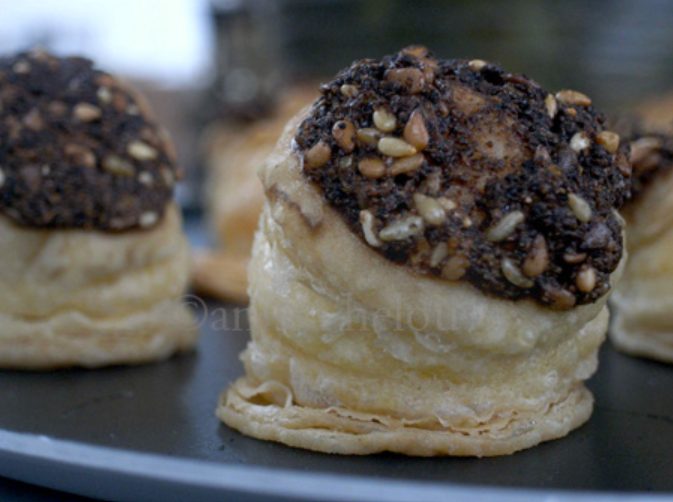
And here is a picture of the za’tar bites which I will serve to those visiting me in my kitchen at the end of my residency. Even when I use Sally Clarke’s puff pastry which is the best in London (the one I used to make those in the pictures is from Waitrose but made with butter), the bites behave like aliens when I bake them and crawl along the baking sheet ending up having the weirdest shapes. I tried making the pastry really cold by refrigerating it before baking and I tried making them bigger but the result is the same. Some puff upright and others crawl. It doesn’t really matter because they taste delicious and don’t disintegrate when you pick them up. Just make sure you use the Lebanese or Jordanian za’tar when baking. The Halabi one will burn, at least according to the za’tar connaisseurs in the souk!

za'tar bites-on baking dish copy

To make your own za’tar

Mix two parts finely ground dried thyme with one part ground sumac and 1/2 part toasted sesame seeds — you can also use a mixture of toasted and raw. Add fine sea salt to taste. Put the za’tar in a frying pan and stir over a medium heat until the aroma rises. This very light toasting helps keep the za’tar for a long time, preferably stored in a hermetically sealed glass or earthenware jar. If you want to make the puff pastry bites, all you need to do is mix the za’tar with a little extra virgin olive oil to have a thick paste which you spread over small thin disks of puff pastry and bake in a hot oven for about 15 minutes or until the pastry is golden brown.

za'tar-fresh thyme 2

A bunch of wild za’tar that my lovely late driver in Beirut, Jamil, picked for me one summer.

Share:

Comments

Leave the first comment

<!-- if comments are disabled for this post then hide comments container -->
<style> 
<?php if(!comments_open()) { echo "#nfps-comments-container {display: none !important;}"; }?>
</style>

za’tar

12, June

Next month, I will start my stint as chef-in-residence at Leighton House as part of their Nour Festival. My first session will be about essential Middle Eastern ingredients and I can’t think of one that has gone more global than za’tar. Some of you may say pomegranate syrup, others labneh and others tahini. You may all be right up to a certain extent but I still think that za’tar is the one that is the best known and the most used by western chefs and foodies.

By now, you probably all know that za’tar is a mixture of dried thyme, sumac and sesame seeds but what is less known is how many varieties there are. The Lebanese and Jordanian za’tar is a simple mixture like the one I describe above but the Syrian one which is known as Halabi (from Aleppo) or red za’tar is made of more ingredients: the three I already mentioned plus cumin, toasted chickpeas, black sunflower seeds and fennel seeds all ground very fine. And within these two main za’tar mixes, you find many variations.

za'tars

Above are pictures of four za’tar mixes and you can see how decidedly different they are. The top left is the Arjawi royal mix. Arjawi is a wonderful za’tar stall in souk el-Bzuriyeh in Damascus where they sell about half a dozen types (the royal one is a mix of all of them). They have the Lebanese (bottom right) and Jordanian (quite similar to the Lebanese although greener) mixes which are those used for manaqish (za’tar ‘pizza’ which I have adapted into dainty za’tar bites using puff pastry instead of pita dough). They also have a mix with pomegranate syrup (top right and one of my favourites) and the halabi or red one which is a speciality from Aleppo (bottom left) although I don’t buy my halabi za’tar from them but rather from al-Qobrossi in the old souk of Aleppo near Qanessrine gate.

za'tar-arjawi's stall in damascus copy

The Arjawi stall in Damascus — his tagline is ‘king of za’tar’

And of course you have the fresh za’tar (za’tar akhdar meaning green thyme) which we use in salads (in the picture mixed with rocket and seasoned with sumac) although the herb used fresh is different from the dried one that is used in the mix. The former has long, rather tender leaves whereas the one that is dried and ground has round, furry leaves and woody stalks. And there is yet a third type which may well be marjoram where the leaves are still round and furry but bigger than those in the picture at the end of the post. This type can be eaten fresh in salads (although it is very strong) or dried.

za'tar-fresh thyme & rocket salad

And here is a picture of the za’tar bites which I will serve to those visiting me in my kitchen at the end of my residency. Even when I use Sally Clarke’s puff pastry which is the best in London (the one I used to make those in the pictures is from Waitrose but made with butter), the bites behave like aliens when I bake them and crawl along the baking sheet ending up having the weirdest shapes. I tried making the pastry really cold by refrigerating it before baking and I tried making them bigger but the result is the same. Some puff upright and others crawl. It doesn’t really matter because they taste delicious and don’t disintegrate when you pick them up. Just make sure you use the Lebanese or Jordanian za’tar when baking. The Halabi one will burn, at least according to the za’tar connaisseurs in the souk!

za'tar bites-on baking dish copy

To make your own za’tar

Mix two parts finely ground dried thyme with one part ground sumac and 1/2 part toasted sesame seeds — you can also use a mixture of toasted and raw. Add fine sea salt to taste. Put the za’tar in a frying pan and stir over a medium heat until the aroma rises. This very light toasting helps keep the za’tar for a long time, preferably stored in a hermetically sealed glass or earthenware jar. If you want to make the puff pastry bites, all you need to do is mix the za’tar with a little extra virgin olive oil to have a thick paste which you spread over small thin disks of puff pastry and bake in a hot oven for about 15 minutes or until the pastry is golden brown.

za'tar-fresh thyme 2

A bunch of wild za’tar that my lovely late driver in Beirut, Jamil, picked for me one summer.

Share:

Comments

Leave the first comment

<!-- if comments are disabled for this post then hide comments container -->
<style> 
<?php if(!comments_open()) { echo "#nfps-comments-container {display: none !important;}"; }?>
</style>

za’tar

12, June

Next month, I will start my stint as chef-in-residence at Leighton House as part of their Nour Festival. My first session will be about essential Middle Eastern ingredients and I can’t think of one that has gone more global than za’tar. Some of you may say pomegranate syrup, others labneh and others tahini. You may all be right up to a certain extent but I still think that za’tar is the one that is the best known and the most used by western chefs and foodies.

By now, you probably all know that za’tar is a mixture of dried thyme, sumac and sesame seeds but what is less known is how many varieties there are. The Lebanese and Jordanian za’tar is a simple mixture like the one I describe above but the Syrian one which is known as Halabi (from Aleppo) or red za’tar is made of more ingredients: the three I already mentioned plus cumin, toasted chickpeas, black sunflower seeds and fennel seeds all ground very fine. And within these two main za’tar mixes, you find many variations.

za'tars

Above are pictures of four za’tar mixes and you can see how decidedly different they are. The top left is the Arjawi royal mix. Arjawi is a wonderful za’tar stall in souk el-Bzuriyeh in Damascus where they sell about half a dozen types (the royal one is a mix of all of them). They have the Lebanese (bottom right) and Jordanian (quite similar to the Lebanese although greener) mixes which are those used for manaqish (za’tar ‘pizza’ which I have adapted into dainty za’tar bites using puff pastry instead of pita dough). They also have a mix with pomegranate syrup (top right and one of my favourites) and the halabi or red one which is a speciality from Aleppo (bottom left) although I don’t buy my halabi za’tar from them but rather from al-Qobrossi in the old souk of Aleppo near Qanessrine gate.

za'tar-arjawi's stall in damascus copy

The Arjawi stall in Damascus — his tagline is ‘king of za’tar’

And of course you have the fresh za’tar (za’tar akhdar meaning green thyme) which we use in salads (in the picture mixed with rocket and seasoned with sumac) although the herb used fresh is different from the dried one that is used in the mix. The former has long, rather tender leaves whereas the one that is dried and ground has round, furry leaves and woody stalks. And there is yet a third type which may well be marjoram where the leaves are still round and furry but bigger than those in the picture at the end of the post. This type can be eaten fresh in salads (although it is very strong) or dried.

za'tar-fresh thyme & rocket salad

And here is a picture of the za’tar bites which I will serve to those visiting me in my kitchen at the end of my residency. Even when I use Sally Clarke’s puff pastry which is the best in London (the one I used to make those in the pictures is from Waitrose but made with butter), the bites behave like aliens when I bake them and crawl along the baking sheet ending up having the weirdest shapes. I tried making the pastry really cold by refrigerating it before baking and I tried making them bigger but the result is the same. Some puff upright and others crawl. It doesn’t really matter because they taste delicious and don’t disintegrate when you pick them up. Just make sure you use the Lebanese or Jordanian za’tar when baking. The Halabi one will burn, at least according to the za’tar connaisseurs in the souk!

za'tar bites-on baking dish copy

To make your own za’tar

Mix two parts finely ground dried thyme with one part ground sumac and 1/2 part toasted sesame seeds — you can also use a mixture of toasted and raw. Add fine sea salt to taste. Put the za’tar in a frying pan and stir over a medium heat until the aroma rises. This very light toasting helps keep the za’tar for a long time, preferably stored in a hermetically sealed glass or earthenware jar. If you want to make the puff pastry bites, all you need to do is mix the za’tar with a little extra virgin olive oil to have a thick paste which you spread over small thin disks of puff pastry and bake in a hot oven for about 15 minutes or until the pastry is golden brown.

za'tar-fresh thyme 2

A bunch of wild za’tar that my lovely late driver in Beirut, Jamil, picked for me one summer.

Share:

Comments

Leave the first comment

<!-- if comments are disabled for this post then hide comments container -->
<style> 
<?php if(!comments_open()) { echo "#nfps-comments-container {display: none !important;}"; }?>
</style>