those fat tails

8, June

Anissa: It has been quite a while since Charles Perry did a guest post here but following a discussion and various questions on twitter about fat tail, I thought I would turn to our chief historian of medieval Arab cookery and ask him to enlighten everyone! Here is what he sent me.

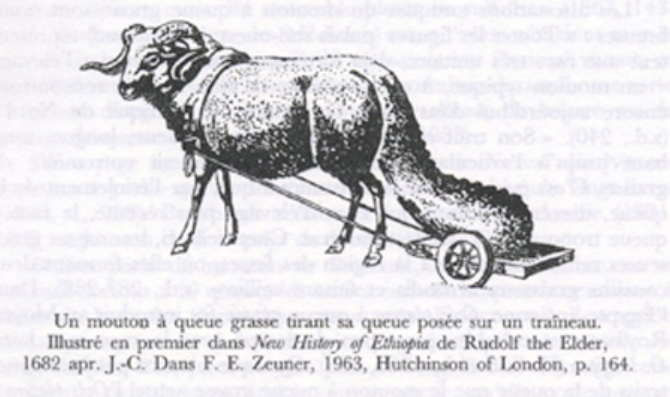
Charles: Europeans and Americans – and Australians, I’m sure – are always amazed when they see the huge tails of Middle Eastern sheep. One of the first to be amazed was Herodotus, who wrote in the 5th century BC that there was a breed in Asia Minor with a tail up to 18 inches wide and another with a tail four and a half feet long. The latter sort, he said, had to be supported by a little cart made for it by the shepherd.

I’ve heard the story that they still make tail carriages in Turkey but I can’t confirm it. And I have to say the dimensions given by Herodotus seem extravagant. Tails of the Awassi variety, which predominates in Lebanon, Syria and Iraq, only reach about 12 inches (30 cm) in width and a little less than that in length, and much larger tails would be a serious obstacle to milking the ewes.
Still, the fat tails can be huge. An adult ram may have a tail weighing 12 kg, of which only 70 g are bone, the rest being nearly pure fat. Ewes have smaller tails, perhaps half as large.
And Herodotus was right, the tails can take several shapes. The Awassi, which probably resembles the original fat-tail breed pretty closely, has a roughly rectangular beaver-tail shape. The Karaman breed, which accounts for two thirds of the sheep in Turkey, also has a beaver tail, except that it has a little S-shaped finial, and the Daglic, which is prominent in west-central Turkey, has a more triangular tail. Central Asian sheep tend to have shorter tails then Middle Eastern, but definitely fatty – they look as if they have little pillows resting on their rumps.

All wild sheep have thin tails, as European sheep do. The fat tail is a feature humans created by breeding sheep to concentrate their subcutaneous fat in the tail. The purpose was convenience in harvesting fat for cooking.

Like all warm-blooded animals, sheep deposit fat in several parts of their bodies. Deep in the interior it takes the convenient form of big chunks, but a lot of fat (in thin-tailed sheep) is deposited right under the skin. This makes it harder to harvest, and it also makes it a different kind of fat. Temperatures are always higher deep in the body, so internal fat has to have a high melting point, while subcutaneous fat is exposed to ambient temperatures and has to have a low melting point for the sheep to be able to metabolize it.
Many westerners have had the experience of starting to work on a lamb chop and then getting distracted by lively conversation, only to find that when they returned to the chop it was lukewarm and chewing it deposited an unpleasant tallowy coating on the roof of the mouth. That’s because sheep have relatively high body temperatures, so their internal fat doesn’t melt in the human mouth.

Tail fat doesn’t have that problem. Since the tail is exposed to low temperatures on four sides, it has a particularly low melting point – it’s more like bacon fat or butter; slightly muttony bacon fat or butter. I think European and American cooks would instinctively remove as much fat as possible from a lamb dish, but in the Middle East and Central Asia, the fat is desirable. In Central Asia, it’s the chief frying fat. Throughout the fat-tail zone people often add a bit of fat to kufta or kebab, or even the clarified butter used for making baklava, in order to add a faint gamy tang.
By the way, that fat-tail zone covers almost all of the Old World. Thin tailed varieties survive only at the margins – Morocco, southern India, Tibet … and, of course, Europe. If it weren’t that Europeans discovered the Americas and Australia and introduced their sheep varieties there, thin-tailed sheep would probably be in the process of disappearing.

A few years ago I presented a paper on tail fat at the Oxford Symposium, and when I gave my opinion that it seemed to be growing less popular, a number of people in the audience hooted at the idea. I still hold to that opinion, though. You still may get a bit of tail fat in your kufta and lahm mishwi in Lebanon and Syria, but it is no longer a predominant cooking fat. Arabic and Turkish cookbooks rarely call for tail these days. In 1993 I visited Uzbekistan, a country where you can smell frying sheep fat in every market and residential neighborhood, and I found that the one gift people would have wanted me to bring them was olive oil, or maybe canola oil, because Uzbeks have become fat-conscious and cholesterol-conscious.

But it’s true that tail fat has enjoyed varying popularity down through the ages. In the 10th-century cookbook Kitab al-Tabikh, it’s quite rare – the usual cooking fat is olive oil. The recipes came from the court at Baghdad, so maybe this just reflects a snobbish preference for an expensive imported ingredient, since the olive doesn’t grow in Iraq. Another Baghdad book with the same name from 300 years later used lots and lots of tail fat. Whenever meat is about to be fried, like clockwork the recipe begins “melt tail.” On the other hand, 240 more recipes were added to that book during the 13th century, and only one of them calls for tail.

Here are a few interesting recipes from the 13th-century Syrian book Kitab al-Wusla ila al-Habib. I have not attempted to work them out because you can’t get tail fat here in Los Angeles. Of course, you could use clarified butter. It wouldn’t give the same flavor as tail fat, but at least it wouldn’t coat the roof of your mouth.
Sharaih misriyya, Another recipe, delicious, the best there is. Take loin meat, cut it in pieces and cut tail fat the same size. Insert two pieces of meat and two pieces of fat on the skewer and roast as mentioned on a charcoal fire. Whenever the fat is about to drip, raise the tip of the skewer so that the fat drips onto the meat. Smear it with rose water and saffron and repeat several times until it is done. Sprinkle coriander seed on it and eat.

Another recipe. Take a liver, boil it and pound with it an equal amount of tail fat, and put hot spices and mixed spices with it. Stuff sausages with it, and it is delicious.

Artificial marrow. Take copper pipes the size of thighbones which are plugged at one end. Then take liver and boil it until done. Take a piece of it and a piece of tail fat, pound them fine and put them in the copper tubes and plug the end with dough. Put them in boiling water and boil until done. Shake them out in the bowl. They come out like marrow in color and flavor.

Harisa is boiled meat shredded and mixed with wheat cooked overnight and then pounded to a smooth consistency. The recipe ends: “Melt fresh tail fat and put it on the surface when you ladle it out. Throw finely ground cumin and cinnamon on it separately. Eat with aged soy sauce and fresh lemon juice.”

Anissa: Thank you Charles. Fascinating. Even today, people in the Emirates pour ghee over h’riss (their name for harisa or Lebanese h’risseh) and I am pretty sure that in some places, they use melted liyeh (arabic for fat tail) instead of ghee.

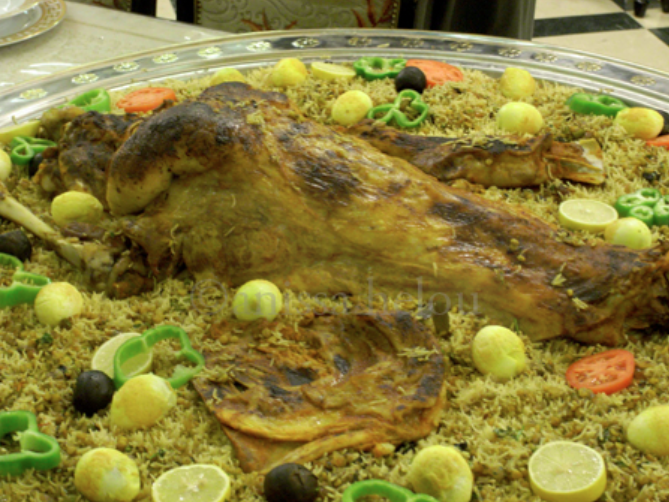
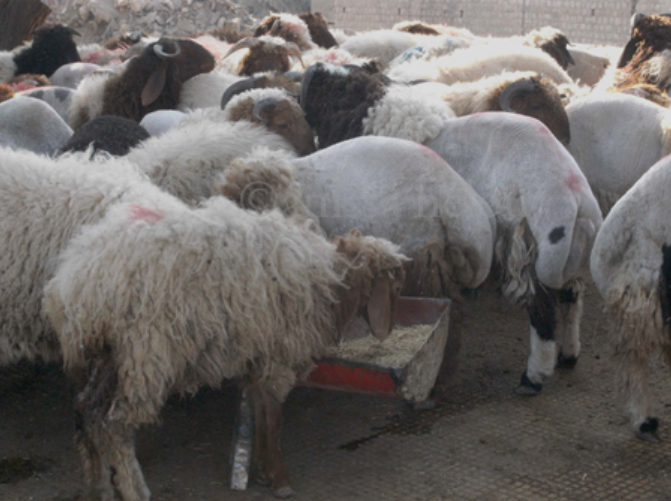
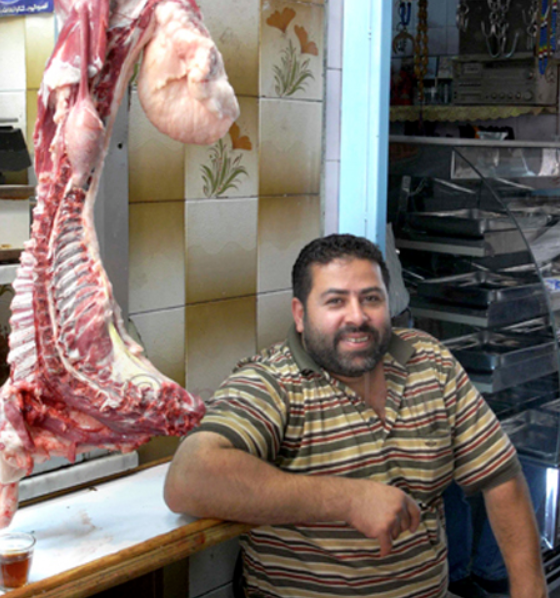
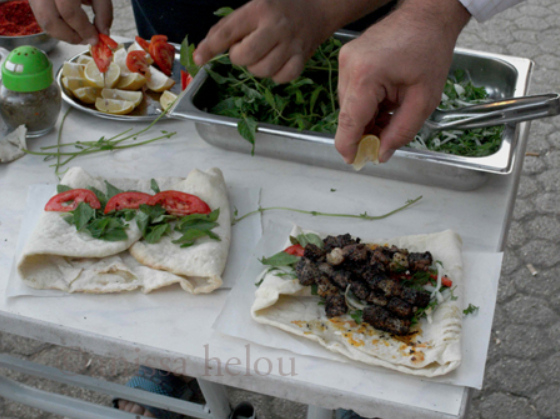
As for the pictures, the top one is of a whole lamb roast that was served at a feast in Doha with the tail on! I took some and it was wonderful. The middle picture is of lambs in a market with some having just been sheared and even though the picture is not brilliant, you can see the shape of the fat tail. The following picture is of a butcher in souk el-Srijeh in Damascus next to a lamb carcass that has most of the fat tail still on while the bottom picture is of a kebab stall in Gaziantep in south eastern Turkey. The white bits are pieces of grilled fat tail. My favourite part!

Ps. I have added the illustration of the sheep dragging his tail on a cart which may be the same one as Charles used in the paper he gave on fat-tail sheep at the Oxford Symposium in 1994. He couldn’t remember where he had taken it from and today, I was writing about Aida Kanafani-Zahar and suddenly I remembered her book, le Mouton et le Murier (the Mutton and the Mulberry Tree) and lo and behold, there was the illustration. So, I scanned it and updated the post. I will also link to Charles’ paper as soon as it is up in google books where all the symposium papers are or will be!

Share:

Comments

Leave the first comment

<!-- if comments are disabled for this post then hide comments container -->
<style> 
<?php if(!comments_open()) { echo "#nfps-comments-container {display: none !important;}"; }?>
</style>

those fat tails

8, June

Anissa: It has been quite a while since Charles Perry did a guest post here but following a discussion and various questions on twitter about fat tail, I thought I would turn to our chief historian of medieval Arab cookery and ask him to enlighten everyone! Here is what he sent me.

Charles: Europeans and Americans – and Australians, I’m sure – are always amazed when they see the huge tails of Middle Eastern sheep. One of the first to be amazed was Herodotus, who wrote in the 5th century BC that there was a breed in Asia Minor with a tail up to 18 inches wide and another with a tail four and a half feet long. The latter sort, he said, had to be supported by a little cart made for it by the shepherd.

I’ve heard the story that they still make tail carriages in Turkey but I can’t confirm it. And I have to say the dimensions given by Herodotus seem extravagant. Tails of the Awassi variety, which predominates in Lebanon, Syria and Iraq, only reach about 12 inches (30 cm) in width and a little less than that in length, and much larger tails would be a serious obstacle to milking the ewes.

Still, the fat tails can be huge. An adult ram may have a tail weighing 12 kg, of which only 70 g are bone, the rest being nearly pure fat. Ewes have smaller tails, perhaps half as large.

And Herodotus was right, the tails can take several shapes. The Awassi, which probably resembles the original fat-tail breed pretty closely, has a roughly rectangular beaver-tail shape. The Karaman breed, which accounts for two thirds of the sheep in Turkey, also has a beaver tail, except that it has a little S-shaped finial, and the Daglic, which is prominent in west-central Turkey, has a more triangular tail. Central Asian sheep tend to have shorter tails then Middle Eastern, but definitely fatty – they look as if they have little pillows resting on their rumps.

All wild sheep have thin tails, as European sheep do. The fat tail is a feature humans created by breeding sheep to concentrate their subcutaneous fat in the tail. The purpose was convenience in harvesting fat for cooking.

Like all warm-blooded animals, sheep deposit fat in several parts of their bodies. Deep in the interior it takes the convenient form of big chunks, but a lot of fat (in thin-tailed sheep) is deposited right under the skin. This makes it harder to harvest, and it also makes it a different kind of fat. Temperatures are always higher deep in the body, so internal fat has to have a high melting point, while subcutaneous fat is exposed to ambient temperatures and has to have a low melting point for the sheep to be able to metabolize it.
Many westerners have had the experience of starting to work on a lamb chop and then getting distracted by lively conversation, only to find that when they returned to the chop it was lukewarm and chewing it deposited an unpleasant tallowy coating on the roof of the mouth. That’s because sheep have relatively high body temperatures, so their internal fat doesn’t melt in the human mouth.

Tail fat doesn’t have that problem. Since the tail is exposed to low temperatures on four sides, it has a particularly low melting point – it’s more like bacon fat or butter; slightly muttony bacon fat or butter. I think European and American cooks would instinctively remove as much fat as possible from a lamb dish, but in the Middle East and Central Asia, the fat is desirable. In Central Asia, it’s the chief frying fat. Throughout the fat-tail zone people often add a bit of fat to kufta or kebab, or even the clarified butter used for making baklava, in order to add a faint gamy tang.

By the way, that fat-tail zone covers almost all of the Old World. Thin tailed varieties survive only at the margins – Morocco, southern India, Tibet … and, of course, Europe. If it weren’t that Europeans discovered the Americas and Australia and introduced their sheep varieties there, thin-tailed sheep would probably be in the process of disappearing.

A few years ago I presented a paper on tail fat at the Oxford Symposium, and when I gave my opinion that it seemed to be growing less popular, a number of people in the audience hooted at the idea. I still hold to that opinion, though. You still may get a bit of tail fat in your kufta and lahm mishwi in Lebanon and Syria, but it is no longer a predominant cooking fat. Arabic and Turkish cookbooks rarely call for tail these days. In 1993 I visited Uzbekistan, a country where you can smell frying sheep fat in every market and residential neighborhood, and I found that the one gift people would have wanted me to bring them was olive oil, or maybe canola oil, because Uzbeks have become fat-conscious and cholesterol-conscious.

But it’s true that tail fat has enjoyed varying popularity down through the ages. In the 10th-century cookbook Kitab al-Tabikh, it’s quite rare – the usual cooking fat is olive oil. The recipes came from the court at Baghdad, so maybe this just reflects a snobbish preference for an expensive imported ingredient, since the olive doesn’t grow in Iraq. Another Baghdad book with the same name from 300 years later used lots and lots of tail fat. Whenever meat is about to be fried, like clockwork the recipe begins “melt tail.” On the other hand, 240 more recipes were added to that book during the 13th century, and only one of them calls for tail.

Here are a few interesting recipes from the 13th-century Syrian book Kitab al-Wusla ila al-Habib. I have not attempted to work them out because you can’t get tail fat here in Los Angeles. Of course, you could use clarified butter. It wouldn’t give the same flavor as tail fat, but at least it wouldn’t coat the roof of your mouth.

Sharaih misriyya, Another recipe, delicious, the best there is. Take loin meat, cut it in pieces and cut tail fat the same size. Insert two pieces of meat and two pieces of fat on the skewer and roast as mentioned on a charcoal fire. Whenever the fat is about to drip, raise the tip of the skewer so that the fat drips onto the meat. Smear it with rose water and saffron and repeat several times until it is done. Sprinkle coriander seed on it and eat.

Another recipe. Take a liver, boil it and pound with it an equal amount of tail fat, and put hot spices and mixed spices with it. Stuff sausages with it, and it is delicious.

Artificial marrow. Take copper pipes the size of thighbones which are plugged at one end. Then take liver and boil it until done. Take a piece of it and a piece of tail fat, pound them fine and put them in the copper tubes and plug the end with dough. Put them in boiling water and boil until done. Shake them out in the bowl. They come out like marrow in color and flavor.

Harisa is boiled meat shredded and mixed with wheat cooked overnight and then pounded to a smooth consistency. The recipe ends: “Melt fresh tail fat and put it on the surface when you ladle it out. Throw finely ground cumin and cinnamon on it separately. Eat with aged soy sauce and fresh lemon juice.”

Anissa: Thank you Charles. Fascinating. Even today, people in the Emirates pour ghee over h’riss (their name for harisa or Lebanese h’risseh) and I am pretty sure that in some places, they use melted liyeh (arabic for fat tail) instead of ghee.

As for the pictures, the top one is of a whole lamb roast that was served at a feast in Doha with the tail on! I took some and it was wonderful. The middle picture is of lambs in a market with some having just been sheared and even though the picture is not brilliant, you can see the shape of the fat tail. The following picture is of a butcher in souk el-Srijeh in Damascus next to a lamb carcass that has most of the fat tail still on while the bottom picture is of a kebab stall in Gaziantep in south eastern Turkey. The white bits are pieces of grilled fat tail. My favourite part!

Ps. I have added the illustration of the sheep dragging his tail on a cart which may be the same one as Charles used in the paper he gave on fat-tail sheep at the Oxford Symposium in 1994. He couldn’t remember where he had taken it from and today, I was writing about Aida Kanafani-Zahar and suddenly I remembered her book, le Mouton et le Murier (the Mutton and the Mulberry Tree) and lo and behold, there was the illustration. So, I scanned it and updated the post. I will also link to Charles’ paper as soon as it is up in google books where all the symposium papers are or will be!

Share:

Comments

Leave the first comment

<!-- if comments are disabled for this post then hide comments container -->
<style> 
<?php if(!comments_open()) { echo "#nfps-comments-container {display: none !important;}"; }?>
</style>

those fat tails

8, June

Anissa: It has been quite a while since Charles Perry did a guest post here but following a discussion and various questions on twitter about fat tail, I thought I would turn to our chief historian of medieval Arab cookery and ask him to enlighten everyone! Here is what he sent me.

Charles: Europeans and Americans – and Australians, I’m sure – are always amazed when they see the huge tails of Middle Eastern sheep. One of the first to be amazed was Herodotus, who wrote in the 5th century BC that there was a breed in Asia Minor with a tail up to 18 inches wide and another with a tail four and a half feet long. The latter sort, he said, had to be supported by a little cart made for it by the shepherd.

I’ve heard the story that they still make tail carriages in Turkey but I can’t confirm it. And I have to say the dimensions given by Herodotus seem extravagant. Tails of the Awassi variety, which predominates in Lebanon, Syria and Iraq, only reach about 12 inches (30 cm) in width and a little less than that in length, and much larger tails would be a serious obstacle to milking the ewes.

Still, the fat tails can be huge. An adult ram may have a tail weighing 12 kg, of which only 70 g are bone, the rest being nearly pure fat. Ewes have smaller tails, perhaps half as large.

And Herodotus was right, the tails can take several shapes. The Awassi, which probably resembles the original fat-tail breed pretty closely, has a roughly rectangular beaver-tail shape. The Karaman breed, which accounts for two thirds of the sheep in Turkey, also has a beaver tail, except that it has a little S-shaped finial, and the Daglic, which is prominent in west-central Turkey, has a more triangular tail. Central Asian sheep tend to have shorter tails then Middle Eastern, but definitely fatty – they look as if they have little pillows resting on their rumps.

All wild sheep have thin tails, as European sheep do. The fat tail is a feature humans created by breeding sheep to concentrate their subcutaneous fat in the tail. The purpose was convenience in harvesting fat for cooking.

Like all warm-blooded animals, sheep deposit fat in several parts of their bodies. Deep in the interior it takes the convenient form of big chunks, but a lot of fat (in thin-tailed sheep) is deposited right under the skin. This makes it harder to harvest, and it also makes it a different kind of fat. Temperatures are always higher deep in the body, so internal fat has to have a high melting point, while subcutaneous fat is exposed to ambient temperatures and has to have a low melting point for the sheep to be able to metabolize it.
Many westerners have had the experience of starting to work on a lamb chop and then getting distracted by lively conversation, only to find that when they returned to the chop it was lukewarm and chewing it deposited an unpleasant tallowy coating on the roof of the mouth. That’s because sheep have relatively high body temperatures, so their internal fat doesn’t melt in the human mouth.

Tail fat doesn’t have that problem. Since the tail is exposed to low temperatures on four sides, it has a particularly low melting point – it’s more like bacon fat or butter; slightly muttony bacon fat or butter. I think European and American cooks would instinctively remove as much fat as possible from a lamb dish, but in the Middle East and Central Asia, the fat is desirable. In Central Asia, it’s the chief frying fat. Throughout the fat-tail zone people often add a bit of fat to kufta or kebab, or even the clarified butter used for making baklava, in order to add a faint gamy tang.

By the way, that fat-tail zone covers almost all of the Old World. Thin tailed varieties survive only at the margins – Morocco, southern India, Tibet … and, of course, Europe. If it weren’t that Europeans discovered the Americas and Australia and introduced their sheep varieties there, thin-tailed sheep would probably be in the process of disappearing.

A few years ago I presented a paper on tail fat at the Oxford Symposium, and when I gave my opinion that it seemed to be growing less popular, a number of people in the audience hooted at the idea. I still hold to that opinion, though. You still may get a bit of tail fat in your kufta and lahm mishwi in Lebanon and Syria, but it is no longer a predominant cooking fat. Arabic and Turkish cookbooks rarely call for tail these days. In 1993 I visited Uzbekistan, a country where you can smell frying sheep fat in every market and residential neighborhood, and I found that the one gift people would have wanted me to bring them was olive oil, or maybe canola oil, because Uzbeks have become fat-conscious and cholesterol-conscious.

But it’s true that tail fat has enjoyed varying popularity down through the ages. In the 10th-century cookbook Kitab al-Tabikh, it’s quite rare – the usual cooking fat is olive oil. The recipes came from the court at Baghdad, so maybe this just reflects a snobbish preference for an expensive imported ingredient, since the olive doesn’t grow in Iraq. Another Baghdad book with the same name from 300 years later used lots and lots of tail fat. Whenever meat is about to be fried, like clockwork the recipe begins “melt tail.” On the other hand, 240 more recipes were added to that book during the 13th century, and only one of them calls for tail.

Here are a few interesting recipes from the 13th-century Syrian book Kitab al-Wusla ila al-Habib. I have not attempted to work them out because you can’t get tail fat here in Los Angeles. Of course, you could use clarified butter. It wouldn’t give the same flavor as tail fat, but at least it wouldn’t coat the roof of your mouth.

Sharaih misriyya, Another recipe, delicious, the best there is. Take loin meat, cut it in pieces and cut tail fat the same size. Insert two pieces of meat and two pieces of fat on the skewer and roast as mentioned on a charcoal fire. Whenever the fat is about to drip, raise the tip of the skewer so that the fat drips onto the meat. Smear it with rose water and saffron and repeat several times until it is done. Sprinkle coriander seed on it and eat.

Another recipe. Take a liver, boil it and pound with it an equal amount of tail fat, and put hot spices and mixed spices with it. Stuff sausages with it, and it is delicious.

Artificial marrow. Take copper pipes the size of thighbones which are plugged at one end. Then take liver and boil it until done. Take a piece of it and a piece of tail fat, pound them fine and put them in the copper tubes and plug the end with dough. Put them in boiling water and boil until done. Shake them out in the bowl. They come out like marrow in color and flavor.

Harisa is boiled meat shredded and mixed with wheat cooked overnight and then pounded to a smooth consistency. The recipe ends: “Melt fresh tail fat and put it on the surface when you ladle it out. Throw finely ground cumin and cinnamon on it separately. Eat with aged soy sauce and fresh lemon juice.”

Anissa: Thank you Charles. Fascinating. Even today, people in the Emirates pour ghee over h’riss (their name for harisa or Lebanese h’risseh) and I am pretty sure that in some places, they use melted liyeh (arabic for fat tail) instead of ghee.

As for the pictures, the top one is of a whole lamb roast that was served at a feast in Doha with the tail on! I took some and it was wonderful. The middle picture is of lambs in a market with some having just been sheared and even though the picture is not brilliant, you can see the shape of the fat tail. The following picture is of a butcher in souk el-Srijeh in Damascus next to a lamb carcass that has most of the fat tail still on while the bottom picture is of a kebab stall in Gaziantep in south eastern Turkey. The white bits are pieces of grilled fat tail. My favourite part!

Ps. I have added the illustration of the sheep dragging his tail on a cart which may be the same one as Charles used in the paper he gave on fat-tail sheep at the Oxford Symposium in 1994. He couldn’t remember where he had taken it from and today, I was writing about Aida Kanafani-Zahar and suddenly I remembered her book, le Mouton et le Murier (the Mutton and the Mulberry Tree) and lo and behold, there was the illustration. So, I scanned it and updated the post. I will also link to Charles’ paper as soon as it is up in google books where all the symposium papers are or will be!

Share:

Comments

Leave the first comment

<!-- if comments are disabled for this post then hide comments container -->
<style> 
<?php if(!comments_open()) { echo "#nfps-comments-container {display: none !important;}"; }?>
</style>