

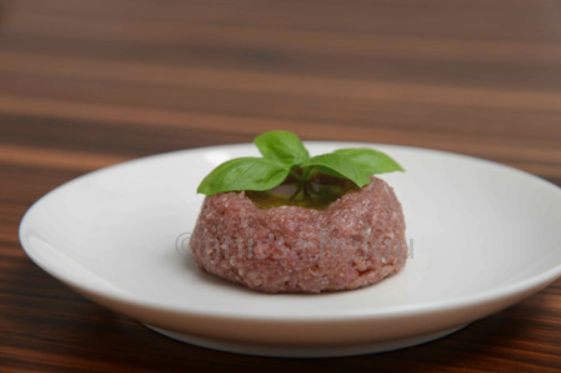
Every now and then I have a perfect lunch and this is what happened today thanks to my friend Jerome and my brand new meat grinder. Jerome (who is head chef at Mosimann’s) gave me some fabulous lamb (from the top of the leg, which he calls single muscle) for me to make kibbeh nayeh. As for the meat grinder, I wouldn’t have bought one if I hadn’t lost Ramiz, my brilliant Lebanese butcher at Zeina who decided to return to the home country. This said, I am pleased to have it because I now have total control over my kibbeh which is not to say that I would not have left this control with Ramiz if he had not abandoned me and many other faithful clients! Anyhow, I thought I would share with you the way to the ultimate kibbeh nayeh.

First, you need to make sure you buy very good and very fresh lamb. Jerome’s is Welsh from a small farm and I suggest you source yours carefully, and use the top of the leg as I do. I could have trimmed all the fat but you need a little with the meat and as there is no way I can get tail fat here (Lebanese butchers always add a little to kibbeh), I left a little of the fat on the meat.

Jerome also helped me pick the meat grinder and when I was proudly showing him my new acquisition, he gave me very good advice telling me to cut the meat in long slices so that I can drop these easily into the mincing shaft without having to force the meat through which would cause the machine to overheat and the meat to darken. A definite no-no for kibbeh nayeh! In fact, I suspect some restaurants use food colouring to keep their kibbeh very pink.

And by watching Ramiz, I learned that for kibbeh (although not for the stuffing if you are making kibbeh bil-saniyeh) you need to mince the meat twice to get it really fine. Here is what it looks like when first ground.

And what it is like the second time round.

Then you need to add a little grated onion. My mother also adds a little fresh basil but I prefer to use it as garnish and/or accompaniment.

The ratio of burghul changes for kibbeh nayeh and you need to use less than for cooked kibbeh. I only use dark burghul and of course fine grade. I stopped taking pictures at this stage as they wouldn’t have looked so nice unless I had beautiful hands like my mother’s in them but she is in far away Lebanon!
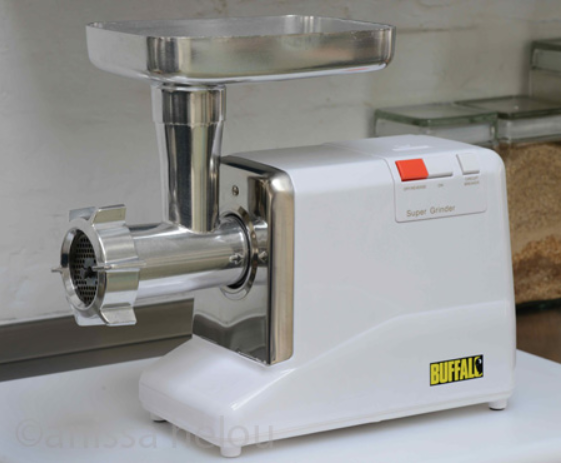
And here is a shot of my beautiful meat grinder which is now officially my favourite kitchen gadget. I will use it again soon to make different versions of kibbeh to share with you. Until then, here is my mother’s recipe. One word of advice: serve kibbeh nayeh as soon as it is ready otherwise it will change colour and become greyish. Also, the burghul will fluff up making the kibbeh less moist although you can easily remedy that by kneading it again with a little iced water. But you can’t change the colour unless you use artificial means which I don’t recommend!
Kibbeh Nayeh
Serves 4 – 6
500 g (1 lb 1 oz) lamb from the top of the leg, boned, skinned and defatted and put through the fine mincer twice
1 small onion, peeled and grated
a handful of fresh basil or mint leaves, very finely chopped (optional)
120 g (4 oz) fine burghul, rinsed under cold water and drained
2 teaspoons ground cinnamon
1 teaspoon ground allspice
1 teaspoon 7-spice mixture (if not available, replace with allspice)
½ teaspoon finely ground black pepper
fine sea salt to taste
pine nuts for garnish, soaked in cold water for an hour or so
Prepare a bowl of lightly salted iced water and have it at hand.
Put the minced meat in a mixing bowl. Add the grated onion and herbs if you are using them and burghul. Season with the cinnamon, allspice, 7-spice mixture and pepper. Add salt to taste and mix with your hand until well blended. moistening the kibbeh every now and then with a little iced water. Knead the kibbeh until the mixture is soft without being too wet
Taste and adjust the seasoning if necessary. Transfer the meat to an oval or round serving dish and flatten it into a shallow cake. Use your index finger or the tip of a small spoon to make little curved dips in a straight line down the middle and again either side of it. Drizzle a little olive oil into the dips, scatter a few pine nuts over the surface and serve immediately with trimmed spring onions and sprigs of fresh mint. As you can see from the top picture, I served mine (to myself!) slightly differently, making small round cakes with a dip in the middle for the olive oil and garnishing with a few basil leaves.
©Anissa Helou from Lebanese Cuisine

